
Ashwagandha and libido: what the evidence shows
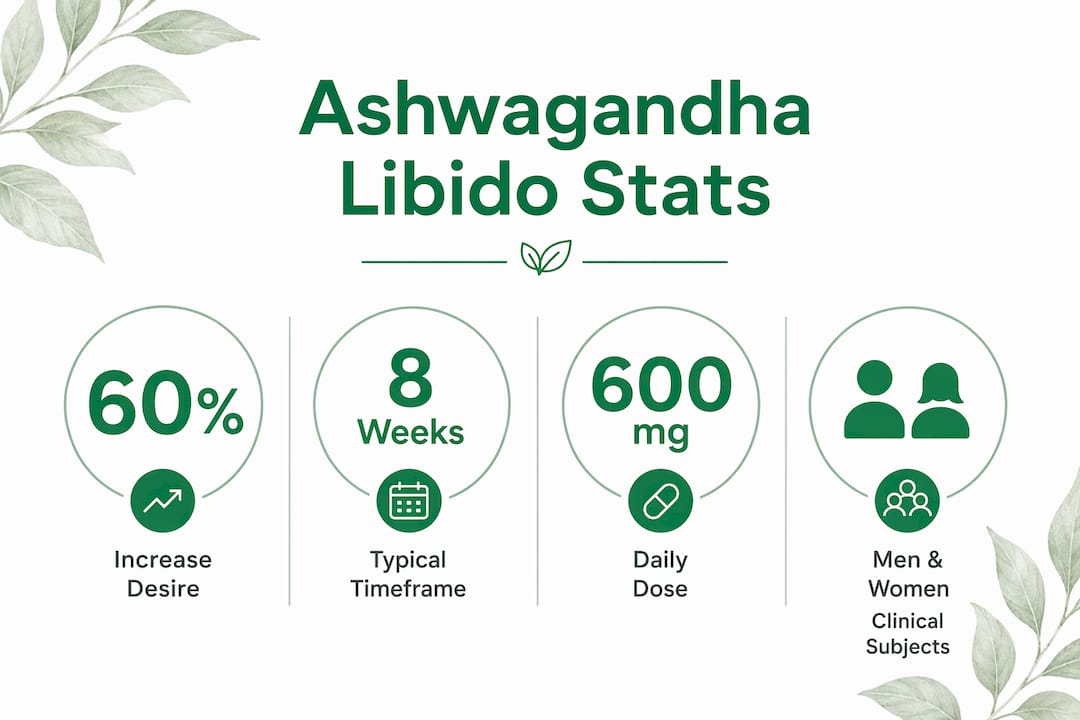
Ashwagandha does modestly improve libido and sexual function in both men and women, based on randomised controlled trials, but it is not an acute aphrodisiac, and effects typically take around 8 weeks of consistent use to become clear. The strongest evidence comes from trials using standardised root extract at 300 mg twice daily, where participants reported meaningful improvements in sexual desire, arousal, and satisfaction scores. Safety note: ashwagandha is not suitable during pregnancy or breastfeeding, and anyone taking thyroid medication, immunosuppressants, or sedatives should speak to their GP before starting it.
Key finding: In an 8-week randomised controlled trial in women with hypoactive sexual desire disorder, FSFI scores improved significantly with ashwagandha versus a smaller change with placebo. A parallel men’s RCT showed statistically significant improvements in sexual desire and serum testosterone over the same period.
Table of Contents
- What the clinical trials show for ashwagandha libido
- How ashwagandha may change sexual desire and function
- Who is most likely to benefit from ashwagandha for sexual health
- How to take ashwagandha for libido: forms, doses and timeframe
- Safety, side effects and UK-specific cautions
- What ashwagandha will and won’t do for your sex life
- Key takeaways
- A note on the evidence and what it means for you
- Nu Sante Nutrition Ashwagandha Gummies
- Sources and further reading
What the clinical trials show for ashwagandha libido
The evidence base is small but consistent. Two well-designed randomised controlled trials form the core of what we know about ashwagandha and sexual health.
Key trials at a glance:
- A prospective, placebo-controlled RCT in 50 men with lower sexual desire found significant DISF-M improvements and increased serum testosterone after 8 weeks of ashwagandha root extract at 300 mg twice daily.
- An 8-week double-blind RCT in 80 women with hypoactive sexual desire disorder reported significant gains in both FSFI (Female Sexual Function Index) and FSDS (Female Sexual Distress Scale) scores with the same dose, with adverse events comparable to placebo.
- A separate prospective RCT in healthy men showed improvements in SDI-2 and IIEF scores alongside measurable gains in semen volume, sperm count, and motility over 8 weeks at 300 mg twice daily.
| Study | Population | Dose and form | Duration | Main result |
|---|---|---|---|---|
| — | 50 men, lower sexual desire | 300 mg twice daily, standardised root extract | 8 weeks | Significant DISF-M and testosterone improvements |
| PubMed 36447681 | 80 women, hypoactive sexual desire disorder | 300 mg twice daily, standardised root extract | 8 weeks | FSFI improved significantly; FSDS reduced; adverse events similar to placebo |
| — | Healthy men | 300 mg twice daily, standardised root extract | 8 weeks | SDI-2, IIEF, semen volume, sperm count and motility all improved |
Limitations worth knowing. Sample sizes across these trials are small, and the populations studied are specific — men with self-reported lower desire and women meeting criteria for hypoactive sexual desire disorder. Placebo responses are common in psychosexual trials, which means the true pharmacological effect may be smaller than headline figures suggest. Heterogeneity across studies also limits how confidently findings can be generalised to the broader population.
How ashwagandha may change sexual desire and function
The most plausible explanation for ashwagandha’s effects on libido is a combination of stress reduction and modest hormonal support, rather than any single direct mechanism.
“Ashwagandha’s action appears multi-dimensional: it reduces physiological and psychological stress while offering modest endocrine support — which explains why benefits are strongest when stress is a primary driver of low libido.” — Frontiers mechanistic review
Stress and cortisol. Chronically elevated cortisol suppresses the hypothalamic-pituitary-gonadal axis, reducing testosterone and oestrogen production and dampening sexual desire. Ashwagandha is classified as an adaptogen, and mechanistic reviews report that it reduces physiological stress markers including cortisol. When stress is the primary driver of low desire, lowering cortisol can restore the hormonal environment that supports libido.
Testosterone in men. The men’s RCTs show measurable increases in serum testosterone alongside improved desire scores. The proposed route involves withanolides, the bioactive steroidal lactones in ashwagandha root, which appear to have androgen-modulating activity. Whether this is a direct androgenic effect or an indirect consequence of reduced cortisol-mediated suppression is not yet fully established.
GABA and GnRH pathways. Withanolides also interact with GABA receptors, and mechanistic literature suggests this GABAergic activity may upregulate gonadotropin-releasing hormone (GnRH) expression, which in turn supports LH and FSH secretion. This is a biologically plausible pathway, but it remains largely preclinical. The clinical trials do not isolate this mechanism, so it should be understood as a working hypothesis rather than a confirmed route.
For women. The women’s RCT improvements in FSFI and FSDS scores are more likely explained by reduced sexual distress and improved quality of life than by direct hormonal changes. The stress-reduction pathway is probably the dominant mechanism here.
To be clear: the cortisol-reduction effect is the most consistently supported step in the chain. The downstream hormonal and receptor effects are plausible and supported by preclinical data, but the full mechanistic picture in humans is not yet proven.
Who is most likely to benefit from ashwagandha for sexual health
Ashwagandha is not a universal libido solution. The trials point to specific profiles where benefit is most likely.
Profiles with a reasonable chance of benefit:
- Adults with stress-related low desire, where elevated cortisol is a plausible contributor
- Men with mild hormonal imbalance or subfertility concerns, given the semen parameter improvements seen in trials
- Women meeting criteria for hypoactive sexual desire disorder, based on the FSFI and FSDS trial data
- People experiencing fatigue-driven low libido alongside general stress load
- Those seeking gradual, sustained support rather than an acute intervention
For men over 40 noticing age-related changes in desire and energy, low testosterone and lifestyle factors often interact — ashwagandha may be one part of a broader approach.
Profiles that need medical assessment first, or are unlikely to benefit:
- Pregnant or breastfeeding people — ashwagandha is contraindicated; do not use
- Anyone on thyroid medication, immunosuppressants, or sedatives without GP clearance
- People with significant hormonal disorders (e.g. hypogonadism, PCOS with complex presentations) where the underlying condition needs direct treatment
- Those with severe erectile dysfunction — this requires medical evaluation, not a supplement trial
- Anyone whose low desire is primarily relationship-based or psychological in origin; ashwagandha does not address those drivers
Women interested in broader hormonal support may also find it useful to read about hormone balancing supplements alongside the specific ashwagandha evidence.
Pro Tip: Before starting ashwagandha, ask yourself one question: is my low desire mainly linked to stress, poor sleep, or fatigue? If yes, a monitored 8-week trial is reasonable. If your desire has dropped sharply, is accompanied by other symptoms, or you are on regular medication, see your GP first.

How to take ashwagandha for libido: forms, doses and timeframe
The clinical trials are consistent on dosing: 300 mg of standardised root extract twice daily, giving a total of 600 mg per day. This is the dose used across the men’s and women’s RCTs, and it is the benchmark against which UK products should be measured.
Timeframe. Clinical improvements typically become measurable around 4–8 weeks, with clearer results by week 8. A single dose does nothing detectable for libido. Consistency is the operative word: skipping days resets the gradual hormonal and stress-modulating process the trials depend on.
| Format | Typical UK dose per serving | Notes |
|---|---|---|
| Standardised root extract capsule | 300–600 mg per serving | Most common clinical format; check withanolide % on label |
| Ashwagandha gummies | Varies by product; check label | Convenient; confirm dose matches clinical range |
| Bulk powder | Variable | Harder to standardise; not recommended for trial purposes |
Quality checklist for UK shoppers:
- Look for “standardised root extract” with a stated withanolide percentage (typically 2.5–5%)
- Check the dose per serving clearly matches or approaches 300 mg per dose
- Prefer products with third-party testing or a certificate of analysis
- Avoid products listing only “ashwagandha powder” with no standardisation detail
- Gummies should state the ashwagandha extract content per gummy, not just total weight
Timing. Taking ashwagandha with food reduces the chance of nausea. There is no strong evidence that time of day matters significantly for libido endpoints, though some people prefer an evening dose given its mild calming properties.
Safety, side effects and UK-specific cautions
Ashwagandha is generally well tolerated at clinical doses. The trials report few adverse events, and those that did occur were comparable in frequency to placebo groups. That said, there are specific situations where caution is warranted.
Common and uncommon side effects reported in trials:
- Mild nausea, particularly on an empty stomach
- Drowsiness or mild sedation, especially at higher doses
- Loose stools or mild gastrointestinal discomfort in some users
- Rare reports of headache
Interactions and contraindications:
- Thyroid medication: ashwagandha may influence thyroid hormone levels; anyone on levothyroxine or other thyroid drugs should consult their GP before use
- Immunosuppressants: ashwagandha has immunomodulatory properties that may interfere with drugs such as ciclosporin or tacrolimus
- Sedatives and anxiolytics: additive sedative effects are possible with benzodiazepines, Z-drugs, or other CNS depressants
- Pregnancy and breastfeeding: clinical safety data is absent for these groups; ashwagandha should not be used
- Autoimmune conditions: the immunostimulatory potential means people with conditions such as rheumatoid arthritis, lupus, or multiple sclerosis should seek medical advice first
When to stop and seek help:
Stop use and contact your GP or pharmacist if you experience signs of an allergic reaction (rash, swelling, difficulty breathing), unusual or severe sedation, or any new thyroid symptoms such as unexplained weight change, palpitations, or temperature sensitivity.
This article is general information, not medical advice. Confirm current guidance with your GP or a qualified pharmacist before starting any supplement, particularly if you take regular medication.
What ashwagandha will and won’t do for your sex life
Ashwagandha is not a substitute for PDE-5 inhibitors such as sildenafil. Those drugs act within an hour by a direct vascular mechanism. Ashwagandha works over weeks through stress modulation and gradual hormonal support — a fundamentally different mode of action.
The magnitude of benefit seen in trials is modest. FSFI scores in the women’s trial improved meaningfully, but participants still had room for further improvement at week 8. In the men’s trials, desire and erectile function scores improved, but the studies did not compare ashwagandha head-to-head with pharmaceutical treatments. The domains most likely to improve are sexual desire, arousal, and overall sexual satisfaction, particularly when stress or fatigue is a contributing factor. Acute erectile function in men with significant vascular or neurological causes is unlikely to respond to ashwagandha alone.
Practical steps that increase the chance of benefit alongside ashwagandha:
- Sleep: poor sleep is one of the strongest suppressors of testosterone and desire; 7–9 hours is the clinical target
- Alcohol: regular heavy drinking reduces testosterone and impairs sexual response; moderation matters
- Stress management: ashwagandha works best when paired with behavioural stress reduction — whether that is structured exercise, mindfulness, or CBT-informed approaches
- Relationship and psychosexual factors: no supplement addresses communication, intimacy, or psychological blocks; these need direct attention if they are present
The evidence supports ashwagandha as one component of a broader approach, not a standalone fix.
Key takeaways
Ashwagandha produces modest, clinically meaningful improvements in libido and sexual function in both men and women when taken as standardised root extract at 300 mg twice daily for at least 8 weeks.
| Point | Details |
|---|---|
| Modest but real benefit | RCTs in men and women show significant improvements in desire, arousal, and satisfaction scores at 8 weeks. |
| Stress is the key driver | Benefits are strongest when low libido is linked to stress, fatigue, or elevated cortisol rather than structural or relationship causes. |
| Dose and timeframe matter | 300 mg twice daily of standardised root extract; allow a full 8-week trial before judging effectiveness. |
| Safety first | Avoid during pregnancy and breastfeeding; consult a GP before use with thyroid medication, immunosuppressants, or sedatives. |
| Nu Sante Nutrition option | Nu Sante Nutrition’s Ashwagandha Gummies offer a convenient UK format; check the dose per gummy matches clinical ranges before starting. |
A note on the evidence and what it means for you
The research on ashwagandha and libido is more rigorous than most supplement categories. Two well-designed RCTs with clear outcome measures give a reasonable basis for cautious optimism, particularly for adults whose low desire is stress-related. The limitations are real — small samples, specific populations, short follow-up — and they matter. Ashwagandha is not a treatment for sexual dysfunction in the clinical sense; it is a supplement with a plausible biological rationale and modest trial support.
Nu Sante Nutrition’s commitment is to products where the ingredient, dose, and form align with what the clinical literature actually used. If you have questions about the product or want to understand more about the evidence, the team is reachable through the website. For anything involving medication or a diagnosed condition, your GP is the right first call.
Nu Sante Nutrition Ashwagandha Gummies
If you want to run a proper 8-week trial without the inconvenience of capsules, Nu Sante Nutrition’s Ashwagandha Gummies are a straightforward UK option. The gummies are formulated with standardised ashwagandha root extract, designed to make daily dosing consistent and easy to maintain — the two things most people fail on with capsules. Check the label for the extract dose per gummy and confirm your daily total sits in the 300–600 mg range used in the clinical trials. The format suits busy routines: no water needed, no measuring, and a fixed dose every time.
Nu Sante Nutrition ships within the UK, and the full product range is available at nusante.com. For a supplement where consistency over 8 weeks is the whole point, a format you will actually take every day is not a minor detail.
Sources and further reading
The sources below are the primary clinical trials and reviews cited in this article. All RCTs are available via PubMed or PMC; links go directly to the study abstract or full text.
| Source | Type | What it covers |
|---|---|---|
| — | Prospective RCT | Men’s sexual desire and testosterone; 300 mg twice daily, 8 weeks; DISF-M outcomes |
| PubMed 36447681 | RCT | Women’s FSFI and FSDS outcomes; 80 participants; 300 mg twice daily, 8 weeks |
| — | RCT and mechanistic review | Healthy men; semen parameters, SDI-2, IIEF; multi-dimensional mechanism perspective |
| PubMed 35873404 | RCT summary | Dosing evidence: 300 mg twice daily; 8-week timeframe for measurable benefit |
| — | Mechanistic review | Adaptogen effects; withanolides; cortisol, GABA/GnRH pathways; standardisation guidance |
How sources were selected. Priority was given to peer-reviewed randomised controlled trials and systematic reviews indexed on PubMed or PMC. Mechanistic reviews were included where they provided direct biological context for the clinical findings. No source was selected solely on the basis of search ranking.