

Best magnesium glycinate gummies: UK buyer's guide 2026
For most UK shoppers, Nu Sante Magnesium Gummies are the top pick for daily magnesium supplementation. They disclose elemental magnesium per serving clearly, use a glycinate form suited to sleep and daily maintenance, and are available direct-to-consumer in the UK. If you want a quick shortlist before reading further:
- Best overall: Nu Sante Magnesium Gummies (disclosed elemental mg, glycinate form, UK direct)
- USP-verified high-elemental dose: shelf brands carrying independent lab verification and explicit elemental mg labelling
- Budget high-dose option: value gummies with a larger per-serving dose at lower cost, though label transparency varies
- Sleep-stack gummy: glycinate combined with L-theanine or ashwagandha for evening use
Adults in the UK often fall short of the recommended daily magnesium intake, which varies depending on individual diet and needs. Gummies can close that gap, but only if the label tells you what you are actually getting. Most do not. Review sites have found that the majority of gummy magnesium products either fail to disclose elemental mg clearly or use proprietary blends that obscure the glycinate ratio.
Table of Contents
- How do the best magnesium glycinate gummies compare?
- Mini-reviews: which magnesium gummy suits you?
- How to choose the right magnesium gummy for your needs
- How these picks were chosen
- Gummies vs capsules: bioavailability, labels and safety
- Key takeaways
- The case for gummies: a practical perspective
- Nu Sante Magnesium Gummies: where to buy
- Sources and further reading
How do the best magnesium glycinate gummies compare?
The table below covers the main options available to UK buyers. Nu Sante Magnesium Gummies leads as the featured pick; the remaining entries represent the key category alternatives a UK shopper is likely to encounter.

| Product | Magnesium form | Elemental mg per serving | Best for | Sugar / sweetener | Vegan / gelatin-free | Price per serving (approx. UK) | Label transparency / testing | UK availability |
|---|---|---|---|---|---|---|---|---|
| Nu Sante Magnesium Gummies | Glycinate | Disclosed on label | Daily maintenance, sleep | Check label | Check label | Direct-to-consumer | Elemental mg disclosed | Direct / nusante.com |
| TRIP Wild Berry Magnesium Gummies | Glycinate blend | Varies by batch | Taste-led daily use | Contains sugar | Vegan | ~£0.30 | Partial disclosure | Holland & Barrett, direct |
| Vitabright Magnesium Glycinate | Bisglycinate | Disclosed | Daily maintenance | Low sugar | Vegan | ~£0.30 | Good label clarity | Amazon UK, direct |
| Prowise Magnesium Glycinate / Advanced 4-in-1 | Multi-compound | Varies | Multi-nutrient support | Low sugar | Vegan | ~£0.30 | Partial | Amazon UK |
| Dr Vegan Magnesium | Bisglycinate | Disclosed | Vegan daily use | Low sugar | Vegan | ~£0.35 | Good | Direct, Amazon UK |
| Zooki Magnesium | Glycinate | Disclosed | On-the-go sachets | Contains sugar | Check label | ~£0.60 | Moderate | Direct, Boots |
| HABI magnesium citrate red apple gummies | Citrate | Disclosed | Budget daily use | Contains sugar | Vegan | ~£0.20–£0.30 | Basic | Amazon UK |
| Third-party verified high-elemental dose (shelf category) | Glycinate / bisglycinate | Clearly disclosed | Buyers wanting lab verification | Varies | Varies | ~£0.35 | USP/NSF badge | Major UK retailers |
| High-dose value gummy (budget category) | Varies | Higher per serving | Cost-conscious buyers | Often higher sugar | Varies | ~£0.20 | Often limited | Amazon UK |
| Sleep-stack gummy (glycinate + calming co-ingredients) | Glycinate + L-theanine / ashwagandha | Lower (check label) | Sleep onset support | Varies | Varies | ~£0.40 | Varies | Direct, Amazon UK |
| Sugar-free / athlete gummy | Glycinate / bisglycinate | Varies | Active, keto-conscious buyers | Sugar-free (polyols) | Varies | ~£0.35 | Varies | Direct, Amazon UK |
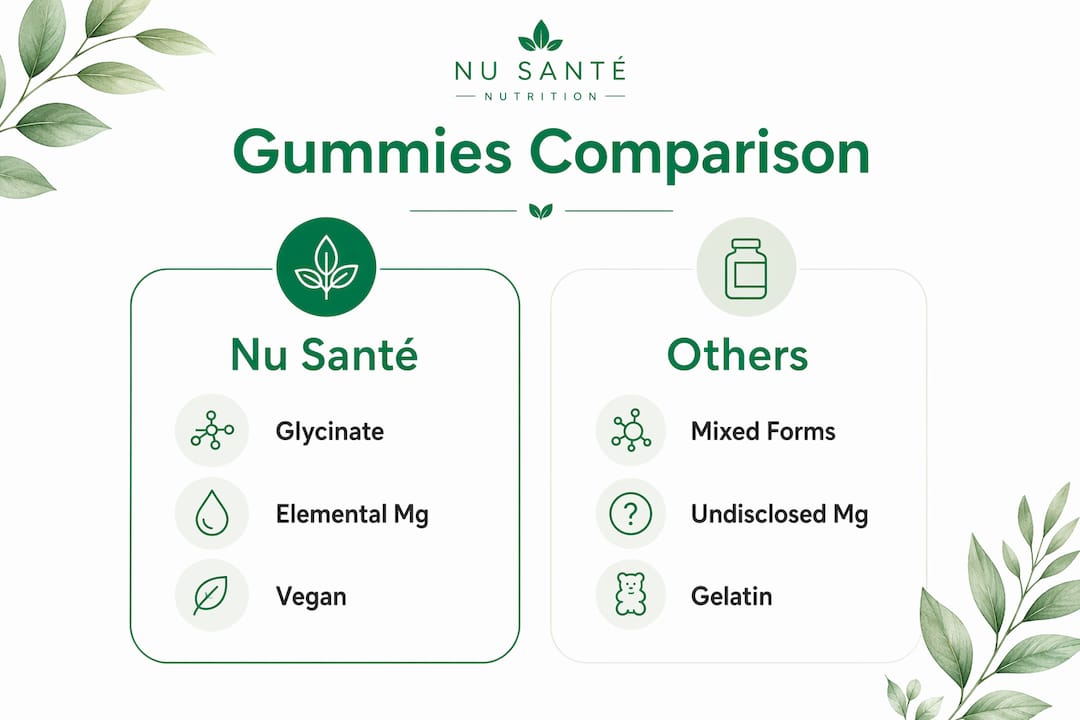
Label transparency and third-party testing are the two strongest trust signals in this category. A product that discloses elemental magnesium per serving and carries a USP or NSF badge gives you independent confirmation that what is on the label is in the gummy. USP and NSF verification is less commonly applied to gummy formats than to capsules, so a publicly available certificate of analysis (COA) is the next best signal when a formal badge is absent.

Mini-reviews: which magnesium gummy suits you?
Nu Sante Magnesium Gummies
Nu Sante Magnesium Gummies are formulated for daily maintenance and evening use, with elemental magnesium per serving disclosed on the label. The glycinate form is well tolerated and suited to sleep support. Taste is a deliberate priority in the formulation, which matters for adherence: palatability and dietary suitability are among the most common reasons people stop taking a supplement.
- Pros: Elemental mg disclosed; glycinate form; taste-forward; UK direct-to-consumer
- Cons: No publicly listed USP/NSF badge at time of writing; check label for vegan status
- Where to buy: nusante.com
TRIP Wild Berry Magnesium Gummies
TRIP’s gummies are widely stocked in Holland & Barrett and appeal to buyers who want a recognisable high-street brand. The wild berry flavour is well reviewed for taste. Elemental mg disclosure is partial on some batch labels, so check the current packaging before purchasing.
- Pros: Widely available; pleasant flavour; vegan
- Cons: Elemental mg not always clearly stated; contains sugar
Vitabright Magnesium Glycinate
Vitabright uses bisglycinate and discloses elemental mg per serving, making it one of the more transparent options on Amazon UK. Low sugar content suits buyers watching calorie intake.
- Pros: Bisglycinate form; good label clarity; low sugar; vegan
- Cons: Available mainly online; no USP/NSF badge listed
Prowise Magnesium Glycinate / Advanced 4-in-1
The 4-in-1 formula combines magnesium with additional nutrients, which suits buyers who want a multi-nutrient gummy rather than a pure magnesium supplement. Elemental mg per serving varies across the product range, so read the specific SKU label carefully.
- Pros: Multi-nutrient convenience; low sugar; vegan
- Cons: Elemental mg can be lower in multi-compound formats; partial label disclosure
Dr Vegan Magnesium
Dr Vegan is a UK-based brand with a clear vegan positioning and bisglycinate form. Label clarity is good, and the brand publishes ingredient sourcing information on its website. Suits buyers who prioritise vegan certification alongside magnesium form.
- Pros: Bisglycinate; vegan certified; good label transparency; UK brand
- Cons: Price per serving is slightly higher than budget alternatives
Zooki Magnesium
Zooki uses a sachet format rather than a traditional gummy, which suits on-the-go use. Elemental mg is disclosed. The price per serving is higher than most gummy options, reflecting the single-serve packaging. Available in Boots and direct.
- Pros: Disclosed elemental mg; convenient sachet format; available in Boots
- Cons: Higher price per serving; contains sugar; check gelatin status
HABI magnesium citrate red apple gummies
HABI uses magnesium citrate rather than glycinate. Citrate is better absorbed than magnesium oxide but can cause looser stools at higher doses. The red apple flavour is distinctive. At roughly £0.20–£0.30 per serving it is among the most affordable options on Amazon UK, but the clinical trade-offs of citrate versus glycinate are worth understanding before choosing.
- Pros: Budget-friendly; pleasant flavour; vegan; widely available on Amazon UK
- Cons: Citrate form, not glycinate; laxative effect at higher doses; basic label detail
Pro Tip: If you are buying primarily for sleep support, check whether the product is a pure magnesium glycinate gummy or a sleep stack. Products marketed for sleep often add adaptogens or amino acids such as L-theanine or ashwagandha. These change the formulation’s purpose from pure magnesium supplementation to a combined sleep aid, which affects how you should count your elemental magnesium intake.
How to choose the right magnesium gummy for your needs
Start with elemental magnesium per serving and explicit disclosure of the magnesium form. Marketing claims on the front of the pack are secondary to what the nutrition panel actually states.
Label checklist:
- Magnesium form stated (glycinate, bisglycinate, or multi-compound blend)
- Elemental magnesium per serving in mg (not just compound weight)
- Serving size (number of gummies per dose)
- Sugar and sweetener type (sucrose, maltitol, stevia, etc.)
- Allergen information
- Vegan / gelatin-free status
- Third-party testing badge (USP, NSF) or COA availability
- Batch or lot number for traceability
Red flags:
- Proprietary blend listing that hides the glycinate proportion
- Only compound weight listed (e.g. “magnesium bisglycinate 426 mg”) with no elemental mg figure
- Implausibly high compound weights without a corresponding elemental mg disclosure
- No batch or lot number on the packaging
Decision flow: which type suits you?
- Daily maintenance: Choose a pure glycinate or bisglycinate gummy with disclosed elemental mg. Prioritise label transparency and a form you will take consistently.
- Sleep support: A pure glycinate gummy taken in the evening works for most people. A sleep-stack gummy (glycinate plus L-theanine or ashwagandha) adds calming co-ingredients but is not a pure magnesium supplement.
- High-dose needs: Look for a product with higher elemental mg per serving and, ideally, a third-party verification badge. Check the upper tolerable intake guidance before exceeding 350–400 mg supplemental elemental magnesium daily without clinician advice.
- Budget priority: Value gummies can deliver adequate elemental mg at lower cost, but check label transparency carefully. A cheap gummy with no elemental mg disclosure may be underdosed.
- Sugar-free / athletic use: Look for gummies sweetened with stevia or erythritol. Check for polyols (maltitol, sorbitol) which can cause digestive discomfort at higher intakes.
How these picks were chosen
Selection followed a consistent set of criteria applied to each product reviewed.
- Label transparency: Does the product disclose elemental magnesium per serving and name the specific magnesium form? Products that list only compound weight or use proprietary blends were rated lower.
- Magnesium form: Glycinate and bisglycinate were prioritised. Citrate and oxide were noted where present, with their clinical trade-offs flagged.
- Third-party testing: USP or NSF badges were treated as the strongest trust signal. Where absent, publicly available COAs or batch-testing documentation were noted. Gummies with clear lab transparency give consumers greater confidence; certificates of analysis were flagged where manufacturers publish them.
- UK availability: Only products available to UK buyers via direct-to-consumer sites, Amazon UK, or major UK retailers (Holland & Barrett, Boots, Sainsbury’s) were included.
- Taste and formulation: Representative taste notes and dietary suitability (vegan, sugar-free, allergen status) were assessed from published product information and consumer reviews.
- Price per serving: Calculated in GBP based on standard pack sizes available in the UK at time of writing.
Testing limits: Independent laboratory assays were not conducted for every product. Label audits, third-party database checks where available, and published COA review formed the basis of the transparency assessment. Readers are encouraged to request current COAs directly from manufacturers and to check for updated certifications. If you spot a new certification or a label change, contact Nu Sante Nutrition via the website.
Gummies vs capsules: bioavailability, labels and safety
Form first, format second. Delivery system does not substantially change magnesium bioavailability when the underlying form is well absorbed. Glycinate and bisglycinate are among the better-absorbed forms regardless of whether they are delivered in a gummy or a capsule. The practical implication: choose the format you will take consistently, then confirm the form and elemental dose on the label.
Elemental mg versus compound weight. The number printed on a gummy label often refers to the compound, not the active dose. Magnesium bisglycinate 426 mg, for example, does not contain 426 mg of elemental magnesium. Practitioners advise calculating elemental mg when only compound weight is disclosed. Magnesium makes up roughly 14% of magnesium bisglycinate by molecular weight, so 426 mg of the compound yields approximately 60 mg of elemental magnesium. That figure is what matters biologically.
Key insight: When a label shows only compound weight, divide by the compound’s elemental fraction to find the active dose. For magnesium bisglycinate, multiply compound weight (mg) by approximately 0.14. For magnesium citrate, the elemental fraction is roughly 0.16. If the label does not give you enough information to do this calculation, treat that as a transparency red flag.
Third-party testing. USP and NSF verification is the gold standard for supplement quality, confirming potency and testing for contaminants. Gummy makers pursue this less commonly than capsule manufacturers, so a COA from an accredited laboratory is the next best signal.
Safety and dosing. Supplemental magnesium in the 100–400 mg elemental range is the typical guidance for adults, but the upper tolerable intake for supplemental magnesium (from non-food sources) is often cited at 350–400 mg without clinician advice. Higher intakes can cause gastrointestinal side effects, most commonly loose stools or diarrhoea. Magnesium can interact with certain antibiotics (tetracyclines, fluoroquinolones) and some heart medications. Consult a clinician before supplementing if you are pregnant, breastfeeding, or taking prescription medication.
Pro Tip: On any product page, scroll past the marketing copy to the supplement facts panel or nutrition information. If elemental magnesium per serving is not stated there in plain mg, the brand has not passed the most basic transparency test.
Key takeaways
Nu Sante Magnesium Gummies is the top pick for UK buyers who want a glycinate gummy with disclosed elemental magnesium, good taste, and direct UK availability.
| Point | Details |
|---|---|
| Form matters most | Choose glycinate or bisglycinate; delivery format is secondary to the magnesium form. |
| Check elemental mg | Compound weight on the label is not the active dose; look for elemental mg per serving explicitly stated. |
| Third-party testing | USP/NSF badges or a published COA are the strongest quality signals; many gummy brands lack them. |
| Dosing and safety | Supplemental magnesium in the 100–400 mg elemental range suits most adults; consult a clinician if on medication. |
| Nu Sante Nutrition | Nu Sante Magnesium Gummies discloses elemental mg, uses glycinate form, and is available direct in the UK. |
The case for gummies: a practical perspective
Most supplement guides treat the gummy-versus-capsule debate as a bioavailability question. It is not, or at least not primarily. The real question is adherence. A capsule you forget to take delivers zero elemental magnesium. A gummy you actually look forward to taking at 9pm delivers whatever the label says, consistently, night after night.
The category’s real problem is not format. It is label quality. Too many gummy products list compound weight in large type and bury elemental mg in small print, or omit it entirely. That is not a minor oversight. It means buyers cannot compare products accurately, cannot calculate whether they are hitting a useful dose, and cannot make an informed decision. The brands that disclose elemental mg clearly and publish COAs are doing the minimum a responsible supplement maker should do. The fact that this still differentiates them from most of the market says something about the category.
For sleep and daily maintenance specifically, glycinate and bisglycinate are the forms worth choosing. They are well tolerated, less likely to cause the laxative effect associated with citrate at higher doses, and the research on magnesium’s role in sleep quality is more consistent for these forms. If you want a sleep stack with L-theanine or ashwagandha added, that is a legitimate choice, but treat it as a separate product category rather than a direct substitute for a pure magnesium supplement.
The practical advice: read the supplement facts panel before the front-of-pack claims, check for elemental mg, confirm the form, and buy from a brand that will show you a COA if you ask.
Nu Sante Magnesium Gummies: where to buy
Nu Sante Magnesium Gummies use a glycinate form with elemental magnesium disclosed per serving, a taste-forward formulation designed for daily use, and direct UK availability. For buyers who want a straightforward glycinate gummy without the label ambiguity common in this category, it is a practical starting point.
Available direct from Nu Sante Nutrition. Check the product page for current pack sizes and any available bundle options.
This article is general information, not medical or nutritional advice. Confirm dosing and suitability with a qualified clinician or pharmacist for your own situation, and check the NHS website for current guidance on magnesium supplementation.
Sources and further reading
- WebMD: Magnesium supplement guide — dosing guidance, upper tolerable intake, side effects and drug interactions.
- Healthline: Best magnesium glycinate supplements — form comparison, bioavailability context, and third-party testing guidance.
- Healthline: Magnesium supplements overview — USP/NSF verification explained; benefits and side effects.
- DeskFitPro: Best magnesium glycinate gummies — label transparency audit, elemental mg calculation methodology, and proprietary blend red flags.
- PubMed Central (PMC) — peer-reviewed research on magnesium absorption and clinical outcomes.
- NHS website — search “magnesium” for UK clinical guidance on recommended intake, deficiency symptoms, and supplement safety.
- USP and NSF International — check product verification databases to confirm whether a specific supplement carries current third-party certification.
For product-specific test reports or certificates of analysis, contact Nu Sante Nutrition directly via nusante.com.