
Hit 300–600mg: Ashwagandha Gummies or Capsules You’ll Actually Take
At a matched dose of the same standardised extract, ashwagandha gummies and capsules work equally well because your body absorbs the active withanolides the same way regardless of delivery format. The real decision comes down to three things: the extract name on the label (KSM-66 or Sensoril, ideally), the milligrams per serving, and whether you’ll actually take it every day. Capsules tend to suit higher-dose, minimal-additive routines. Gummies win when consistency is your weak spot, provided they meet clinical-dose criteria.
TL;DR:
- Both gummies and capsules deliver equivalent efficacy at the same dose of standardised extract, such as KSM-66 or Sensoril, regardless of format.
- Capsules generally provide a more precise dose of 300 to 600mg in a single unit, while gummies often require multiple units to reach clinical doses.
- Gummies are more convenient for maintaining daily adherence but tend to contain added sugars and have a shorter shelf life than capsules.
- The most critical factors when choosing a supplement are extract name, milligrams per serving, standardisation percentage, and third-party testing, not the format.
- Long-term safety beyond three months is not as well established, so users should consult healthcare professionals before extended use.
Table of Contents
- Ashwagandha gummies vs capsules: the trade-offs at a glance
- What does the clinical evidence say about dose and format?
- When are ashwagandha gummies the better choice?
- When are ashwagandha capsules the better choice?
- How do you choose between ashwagandha gummies and capsules?
- Why the format debate misses the real question
- Try an ashwagandha gummy built around clinical dosing
- Sources
- FAQ
Ashwagandha gummies vs capsules: the trade-offs at a glance
Format alone rarely decides efficacy. What separates a good ashwagandha supplement from a mediocre one is what’s actually printed on the supplement facts panel, and how that translates into daily habit.
Here’s what to check before you buy either format:
- Dose per unit: capsules typically pack 300 to 600mg of extract each; gummies often need 2 to 3 units to reach the same amount, because of formulation limits.
- Sugar and excipients: gummies carry added sugar or sugar alcohols and gelling agents; capsules usually contain just the extract plus a filler.
- Allergen risk: gummies frequently use gelatine or pectin plus flavourings, which matters if you have dietary restrictions capsules might avoid.
- Taste and adherence: gummies are easier to remember and enjoy; capsules are flavourless but demand more discipline.
- Shelf life and stability: capsules generally store longer and tolerate heat better than gummies, which can soften or clump.
- Cost per effective dose: divide price by the milligrams of named extract you actually get, not the total gummies in the tub.
The label check that matters most is simple: find the extract name and the milligrams per serving before anything else influences your choice.
What does the clinical evidence say about dose and format?
Once you dissolve a gummy or swallow a capsule, your gut doesn’t distinguish between them. It absorbs withanolides the same way, provided the standardised extract and dose match. This is why format is rarely the variable that matters in trials.
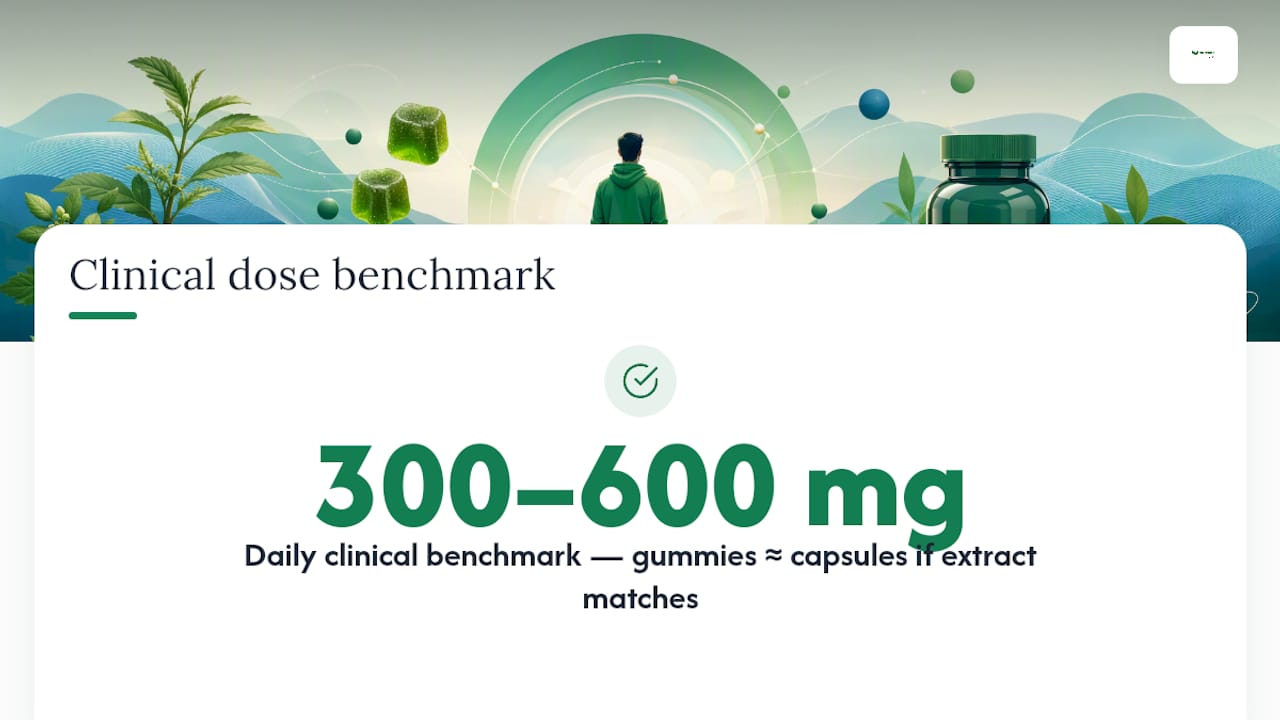
Most clinical research on ashwagandha uses doses between roughly 300 and 600mg per day of standardised extract, with benefits reported for perceived stress and some sleep measures. That range is the benchmark worth holding any product against, gummy or capsule.
Two extracts dominate the research: KSM-66, a full spectrum root extract, and Sensoril, which combines root and leaf. Both carry the strongest clinical datasets, and withanolide standardisation on these matters because it tells you the active compound content is consistent batch to batch, not an estimate.
A 2024 review of ashwagandha and performance outcomes found reduced perceived stress and improved sleep metrics across multiple randomised trials, alongside some physical performance benefits. The evidence is promising, not definitive at scale.
Safety data mostly cover use up to around three months, with signals around liver enzymes and thyroid function worth flagging if you have existing conditions; learn more about potential PEMF therapy side effects. Pregnant readers and anyone on thyroid, blood pressure, or blood sugar medication should speak to a clinician before starting, whichever format they pick. For a deeper dive into UK-relevant dosing, our ashwagandha for anxiety guide breaks down the trial data further.
When are ashwagandha gummies the better choice?
Gummies solve the problem most supplements actually fail on: people forget, skip days, or quietly stop bothering. If taste and habit are what derail your routine, a gummy format removes that friction entirely.
The trade-offs are real, though:
- Lower extract per unit means you may need multiple gummies to hit a clinical dose, not just one.
- Added sugar, sugar alcohols, and flavourings increase the ingredient list beyond the active extract.
- Shelf life tends to be shorter than capsules, and heat exposure can affect texture and potency over time.
- Cost per effective milligram can run higher once you account for needing several gummies per serving.
Many gummies on the market under-dose relative to trial standards purely because of formulation constraints. It’s genuinely difficult to pack 300mg of extract into a gummy without making it the size of a small biscuit, so brands often recommend two or three per dose instead.
Pro Tip: Compare the milligrams of standardised extract per serving, not the front-of-pack “raw powder” figure. A gummy boasting “1,000mg ashwagandha” might mean raw root powder equivalent, not the concentrated extract that trials actually used.
When are ashwagandha capsules the better choice?
Capsules exist for one reason above all others: precision. If you want to hit an exact clinical dose without juggling multiple units, a capsule delivers it in one go.
Their strengths line up clearly:
- Easier to reach the full 300 to 600mg trial-tested dose in a single capsule.
- Fewer additives overall, since there’s no need for sugar or gelling agents to hold a shape.
- Generally lower cost per milligram of active extract than an equivalent gummy dose.
- Longer shelf stability, particularly in vegetarian capsule shells that resist humidity better than gelatine.
The downsides are mostly about the swallowing experience. Some people genuinely struggle with capsules, and that aversion can hurt adherence just as much as a low-dose gummy does. Check whether the shell is vegetarian or gelatine-based if that matters to you, and always confirm the extract name and standardisation percentage on the label. Third-party testing, where a batch is verified independently for potency and contaminants, is worth checking for too. Our guide to ashwagandha side effects covers what to watch for regardless of format.
How do you choose between ashwagandha gummies and capsules?
Run through this checklist before you commit to either:
- Confirm the extract name. Look for KSM-66 or Sensoril specifically, not a generic “ashwagandha extract” listing.
- Check the milligrams per serving, and note whether that’s per capsule or per the total gummies needed for one dose.
- Look for withanolide percentage or standardisation details, which tell you the extract’s potency is consistent.
- Count the units per serving. If a gummy label says “take three daily,” multiply the per-gummy dose by three to get your real total.
- Ask whether a Certificate of Analysis is available. Reputable brands will show third-party testing results on request.
- Scan for sugar and allergens if you’re managing diabetes, coeliac disease, or other dietary restrictions.
- Work out cost per effective milligram, not just price per bottle.
Once you’ve picked a product that clears every check above, commit to it for six to eight weeks before judging whether it’s working. Doctors evaluating ashwagandha efficacy generally recommend this window because stress and sleep improvements build gradually rather than appearing overnight. Track how you feel weekly, and if you’re on medication or pregnant, loop in a healthcare professional before you start. Our testing schedule guide walks through exactly how to structure that trial period.
Why the format debate misses the real question
Most of the “gummies versus capsules” content online treats this as a binary rivalry, as if one format is inherently superior. It isn’t. The debate that actually matters is extract standardisation and dose accuracy, and format is just the vehicle that carries it.
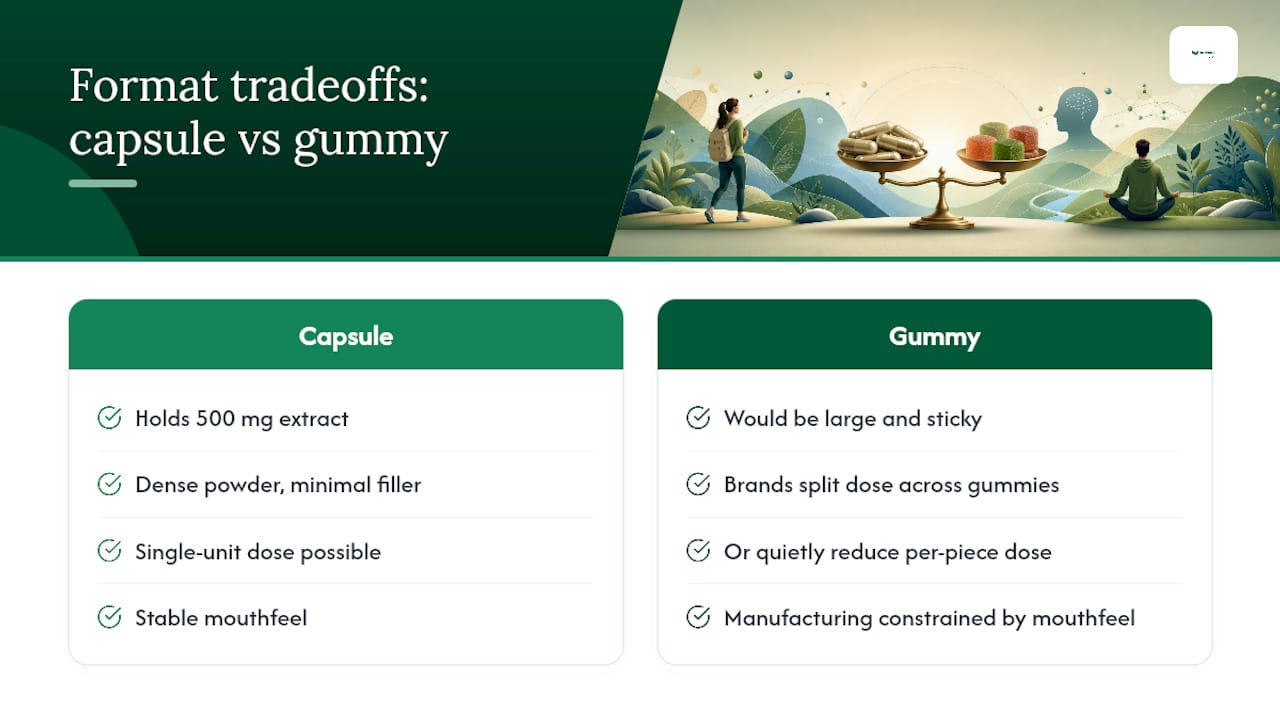
What’s underappreciated is how much manufacturing constraint shapes the gummy category specifically. A capsule can hold 500mg of dense extract powder with almost no filler. A gummy carrying the same 500mg would be an unpleasantly large, sticky mouthful, so brands split the dose across multiple gummies or quietly reduce it. That’s not dishonesty. It’s chemistry and mouthfeel colliding with clinical dosing targets, and it’s exactly the design challenge Nusante’s product range is built around, alongside formats like Mushroom, Creatine, and Magnesium Gummies that face the same constraint.
The uncomfortable truth for anyone chasing the “best” format is that adherence beats precision if the precision never gets taken consistently. A perfectly dosed capsule left in a drawer helps nobody.
— Andy
Try an ashwagandha gummy built around clinical dosing
An ashwagandha gummy designed around the principle this article has argued from the start: clear labelling and a dose you’ll actually take beat a bottle of capsules gathering dust in a cupboard. Each serving is built with adherence and transparent milligram-per-serving figures in mind, so you’re not left guessing how many gummies equal a proper dose.
Before you buy anything, gummy or capsule, check the supplement facts panel for the extract name and milligrams per serving, then commit to a six to eight week test period to judge whether it’s working for you. If you’re pregnant or taking medication, speak to your clinician first. Read more on what a gummy-first approach gets right when dose is preserved, or explore Nusante’s full range to see how the same design principle applies across Turmeric, Collagen, and Multivitamin Gummies too.
Sources
Harvard Health covers clinical dose ranges and general benefit data. The NIH Office of Dietary Supplements details safety limits and duration guidance. Frontiers in Nutrition reviews performance and extract-specific evidence, while PMC’s trial archive holds the individual randomised trials behind these claims.
This article is general information, not a substitute for advice from a qualified doctor. Consult a qualified healthcare professional about your own circumstances before acting on anything here.
- Ashwagandha: Benefits, side effects, and safety concerns - Harvard Health
- Ashwagandha (Withania somnifera) - Office of Dietary Supplements, NIH
- Frontiers in Nutrition — review on ashwagandha and performance (2024)
FAQ
Which works better, ashwagandha gummies or capsules?
Neither format is inherently better. At matched doses of the same standardised extract (KSM-66 or Sensoril), both deliver equivalent results, so the real choice depends on which one you’ll take consistently.
What is the most effective form to take ashwagandha in?
The most effective form is whichever one gets you to the clinical dose window of 300 to 600mg per day of standardised extract, taken daily for at least six to eight weeks.
What are the downsides of ashwagandha gummies?
Gummies often contain less extract per unit than capsules, meaning you may need two or three to match a single capsule’s dose, plus added sugar and excipients that capsules typically avoid.
Why can you only take ashwagandha for three months?
Safety data mostly covers use up to around three months, so long-term safety beyond that point is less well established; anyone wanting to use it longer should check in with a healthcare professional first.