

Ashwagandha side effects: what you need to know
Ashwagandha most commonly causes mild gastrointestinal upset, loose stools, nausea, and drowsiness. Rarely, it has been linked to liver injury and thyroid changes. If you experience jaundice, severe abdominal pain, or difficulty breathing, stop taking the product immediately and contact your GP or call 999. For any suspected adverse reaction in the UK, you can report it via the MHRA Yellow Card scheme.
This is general information, not a substitute for professional clinical advice. Confirm your personal situation with a GP or pharmacist before starting or continuing any supplement.
Key takeaways
Ashwagandha is generally well tolerated short-term, but liver injury cases, thyroid effects, and significant drug interactions mean that safety depends heavily on who is taking it, what product they use, and for how long.
| Point | Details |
|---|---|
| Common side effects | Stomach upset, loose stools, nausea, and drowsiness are the most frequently reported effects; usually mild and short-lived. |
| Serious red flags | Stop immediately and seek urgent care for jaundice, dark urine, severe abdominal pain, breathing difficulty, or widespread rash. |
| Who should avoid it | Pregnant people, those with thyroid or autoimmune conditions, people on immunosuppressants, and those awaiting surgery should not use ashwagandha without medical advice. |
| Choose quality products | Use third-party tested products with a declared withanolide percentage; avoid products with undisclosed additional ingredients. |
| Nu Sante Nutrition option | Nu Sante Nutrition Ashwagandha Gummies use clearly labelled, GMP-produced formulas with third-party testing for those who choose a gummy format. |
Table of Contents
- What is ashwagandha and why do people take it?
- What are the common ashwagandha side effects?
- Serious or rare adverse effects: what the evidence shows
- Who should avoid ashwagandha or use it with caution?
- Drug and supplement interactions to watch for
- Doses, forms, and product quality: what clinical trials actually used
- How to reduce risk when taking ashwagandha
- What to do if you get side effects
- What does the research actually say about ashwagandha safety?
- A balanced view on ashwagandha safety
- Nu Sante Nutrition ashwagandha gummies: quality you can check
- Sources
What is ashwagandha and why do people take it?
Ashwagandha (Withania somnifera) is a plant root used in Ayurvedic medicine, now widely sold as a supplement for stress relief, sleep support, and general wellbeing. It is classified as an adaptogen, meaning it is thought to help the body manage physiological stress responses.
Common forms include:
- Root powder — the whole dried root, typically less concentrated
- Standardised extracts — concentrated preparations with a declared withanolide percentage (usually 2.5–5%), offering more consistent dosing
- Tinctures — liquid extracts, variable in concentration
- Gummies and combination products — convenient formats that may use either root powder or extract; potency varies considerably by brand
The distinction between root powder and standardised extract matters for safety. A product labelled simply “ashwagandha root” may deliver a very different dose of active withanolides than one specifying “KSM-66” or “Sensoril” extract at a declared percentage. Product variability is one reason why reported side effects and their severity differ across users and studies.
What are the common ashwagandha side effects?
According to the NIH Office of Dietary Supplements, the most frequently reported side effects are mild and tend to resolve after stopping use. A critical review published on PubMed collating adverse event reports identifies gastrointestinal symptoms as the most consistent finding across trials and case series.
Common effects include:
- Stomach upset and abdominal discomfort — the most frequently reported complaint, often appearing within the first few days
- Loose stools or diarrhoea — particularly at higher doses
- Nausea or vomiting — usually mild and short-lived
- Drowsiness or sedation — relevant if you drive or operate machinery
- Headache — reported in some trial participants
Onset is typically within hours to a few days of starting. Most effects resolve once the supplement is stopped or the dose is reduced.
Note on frequency: Clinical trials generally report these effects as mild and transient. However, individual responses vary. Harvard Health notes that some people experience paradoxical stimulation or increased anxiety rather than the calming effect they expected, which underscores the need to monitor your own response carefully.
Serious or rare adverse effects: what the evidence shows
Serious reactions are uncommon, but they have been documented. The most clinically significant is acute liver injury (drug-induced hepatitis). Case reports describe individuals developing jaundice, elevated liver enzymes, and in some instances requiring hospitalisation after taking ashwagandha products. A critical review on PubMed notes that reported harms include gastrointestinal effects, immune hypersensitivity, liver toxicity, and endocrine disruption, though many reports are single cases or small series, making firm causal attribution difficult.

Memorial Sloan Kettering Cancer Center documents additional rare events: thyroid hormone changes, at least one case of transplant rejection temporally associated with ashwagandha use, and acute neurotoxicity. Symptoms generally resolved after stopping the product and receiving standard care.
A small trial found increases in thyroid hormones with 500 mg/day for eight weeks in a limited sample, suggesting that thyroid effects are biologically plausible, particularly in people with pre-existing thyroid conditions.
An important caveat: some products involved in case reports contained additional herbal or mineral ingredients, and their contents were not always independently verified. This complicates causality assessment.
Red-flag symptoms requiring immediate medical attention: jaundice (yellowing of skin or eyes), dark urine, severe or persistent abdominal pain, difficulty breathing, widespread skin rash or hives, and fainting. If you experience any of these, stop taking ashwagandha and seek urgent care. Bring the product packaging with you.
Who should avoid ashwagandha or use it with caution?
Certain groups face higher risk and should either avoid ashwagandha entirely or use it only under direct medical supervision. NCCIH advises avoiding use during pregnancy, and WebMD recommends disclosing all supplements to your healthcare provider before starting.
Groups who should not take ashwagandha without medical advice:
- Pregnant people — avoid entirely; traditional use as an abortifacient and absence of safety data make this a firm contraindication
- Breastfeeding people — insufficient safety data; avoid until more is known
- People with thyroid disorders — ashwagandha may alter thyroid hormone levels; consult your endocrinologist before use
- People with autoimmune conditions (e.g., rheumatoid arthritis, lupus, multiple sclerosis) — ashwagandha may stimulate immune activity, potentially worsening these conditions
- People with hormone-sensitive prostate cancer — possible hormonal effects warrant oncologist review
- Those scheduled for surgery — stop at least two weeks before any planned procedure due to potential sedative and blood-pressure effects
- Children — data are very limited; consult a clinician before considering use
- Older adults — limited trial data in this group; a GP review is advisable, particularly if multiple medicines are in use
If you fall into any of these categories, the appropriate specialist to consult depends on your condition: an obstetrician, endocrinologist, oncologist, or transplant team as relevant.
Drug and supplement interactions to watch for
Ashwagandha can interact with several medicine classes. WebMD advises telling your healthcare provider about all medicines before starting. Review your full medicines list with your GP or pharmacist before adding any supplement.
Key interaction classes:
- Sedatives and sleep aids (e.g., benzodiazepines, antihistamines, opioids) — additive drowsiness; combination may impair alertness and reaction time
- Thyroid hormone and antithyroid drugs (e.g., levothyroxine, carbimazole) — ashwagandha may raise or alter thyroid hormone levels, shifting the balance of prescribed therapy
- Antidiabetic medicines (e.g., metformin, insulin, sulfonylureas) — possible additive blood-glucose lowering; monitor for hypoglycaemia
- Antihypertensives (e.g., amlodipine, ramipril) — additive blood-pressure reduction; may cause dizziness or falls, particularly in older adults
- Immunosuppressants (e.g., ciclosporin, tacrolimus) — potential immune-modulating effects; the transplant rejection case documented by MSKCC is a relevant signal here
- Anticonvulsants (e.g., sodium valproate, levetiracetam) — possible CNS effects; limited data but caution is warranted
- Monoamine oxidase inhibitors and serotonergic drugs — potential for adverse CNS interactions; avoid combination without specialist advice
Keep an up-to-date written list of all medicines, supplements, and herbal products and share it at every GP or pharmacist appointment. This is the single most practical step for avoiding interactions.
Doses, forms, and product quality: what clinical trials actually used
Most clinical trials of ashwagandha use standardised root extracts rather than whole-root powder. Typical doses in published trials range from approximately 300 mg twice daily to 500 mg once daily, with study durations mostly between 8 and 12 weeks. NCCIH notes that trials are generally short-term, and long-term safety data remain limited.
The difference between a standardised extract and whole-root powder is not trivial. Products that do not declare their withanolide content make it difficult to assess dose or compare with trial data.
Product quality checklist:
- Clear withanolide percentage on the label
- Third-party testing certificate (e.g., NSF, Informed Sport, or equivalent)
- GMP (Good Manufacturing Practice) certification
- Full ingredient list with no undisclosed herbal or mineral additions
- Batch traceability information
Avoid products that list only “ashwagandha root” with no extract ratio or withanolide declaration.
How to reduce risk when taking ashwagandha
A stepwise approach reduces the likelihood of problems, particularly for first-time users.
- Check contraindications first. Review the groups listed above. If you fall into one, consult your GP before purchasing.
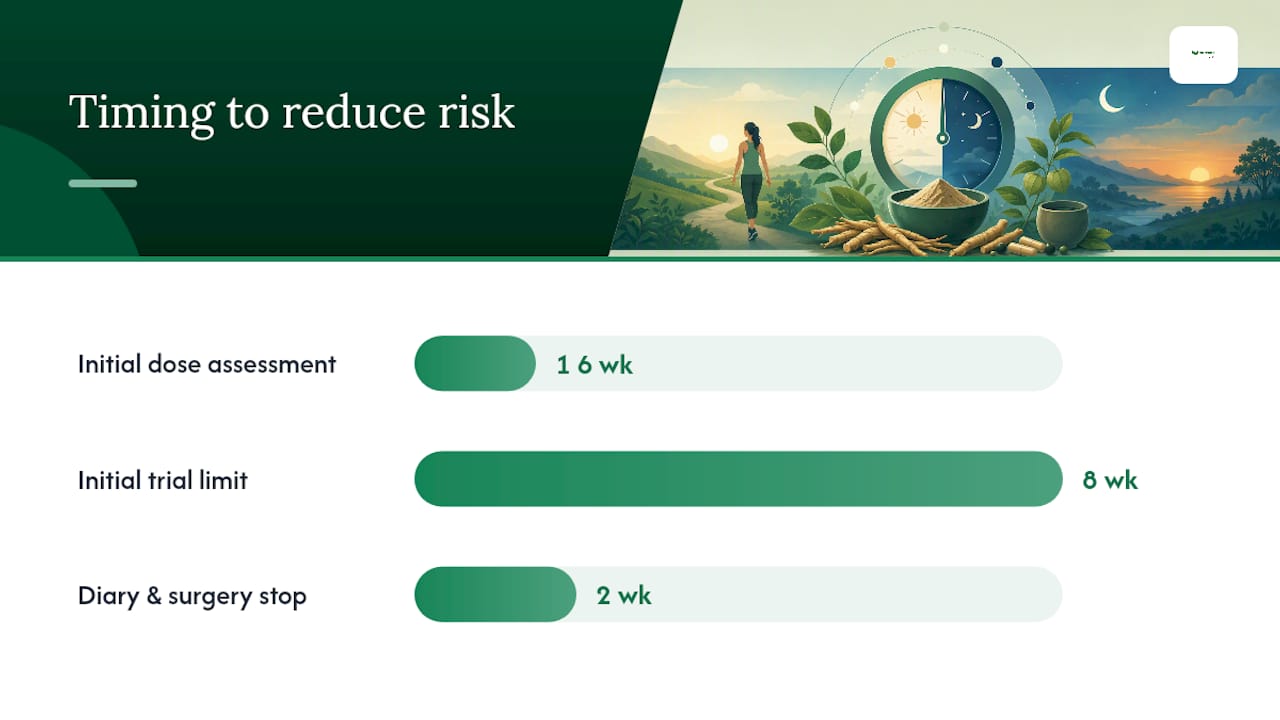
- Start at a low dose. Begin at the lower end of the product’s recommended range and assess your response over one to two weeks before increasing.
- Choose a quality product. Use the checklist above: third-party tested, GMP-certified, clear withanolide labelling.
- Set a defined trial period. Limit initial use to eight weeks. Reassess whether you are noticing benefit before continuing.
- Review your medicines list. Share it with your GP or pharmacist before starting.
- Monitor actively. Note any new symptoms, particularly gastrointestinal changes, unusual fatigue, or mood shifts. Stop if symptoms appear.
- Seek baseline checks if you are higher risk. People with thyroid conditions or liver disease should consider baseline liver function tests (LFTs) and thyroid function tests before starting, and repeat them if symptoms develop.
- Stop before surgery. Discontinue at least two weeks before any planned procedure.
- Report adverse reactions. In the UK, use the MHRA Yellow Card to report any suspected reaction. This supports national safety monitoring and helps identify patterns in supplement-related harms.
Pro Tip: Keep a simple symptom diary for the first two weeks. Note the date, dose, and any new symptoms. If you need to consult your GP, this record is far more useful than trying to recall details from memory.
What to do if you get side effects
For mild effects (stomach upset, loose stools, mild drowsiness):
- Pause use and note whether symptoms resolve within 24–48 hours
- If they do, consider restarting at a lower dose or with food
- Record the product name, batch number, and dose taken
- If symptoms persist beyond a few days, stop entirely and consult your GP or pharmacist
For serious or red-flag symptoms:
- Stop immediately. Do not take another dose.
- Seek urgent medical care: contact your GP, call 111, or call 999 for severe symptoms (difficulty breathing, fainting, severe abdominal pain, jaundice)
- Bring the product packaging to the clinician so they can review ingredients and contact the manufacturer if needed
- Report the reaction via the MHRA Yellow Card scheme, whether or not you seek medical care
Red-flag symptoms to act on without delay: yellowing of skin or eyes, dark or cola-coloured urine, severe abdominal pain, swelling of the face or throat, widespread rash, or sudden loss of consciousness.
What does the research actually say about ashwagandha safety?
The honest summary is that short-term tolerability is reasonably well documented, but long-term safety is not. Harvard Health notes that while many people tolerate short courses and some report benefit, data on long-term safety are limited. Ongoing registered trials are largely short in duration, and long-term randomised safety studies are largely absent.
The core evidence gap: Most trials run for 8–12 weeks, use specific proprietary extracts, and involve relatively small samples. Short-term tolerability in these conditions cannot be extrapolated to indefinite daily use, different product formulations, or populations not represented in the trials (older adults, people with multiple health conditions, children). Rare harms such as liver injury appear in case reports rather than controlled trials, which makes frequency estimation difficult but does not make the signal dismissible.
Product heterogeneity adds another layer of uncertainty. When a case report involves a product containing multiple herbal ingredients, attributing harm to ashwagandha specifically is genuinely difficult. This is why third-party tested, single-ingredient products are preferable for anyone who wants to assess their own response clearly.
Clinicians and users alike should treat short-term tolerability data as exactly that: evidence that most people do not experience serious problems over a few weeks, not proof that indefinite use is safe.
A balanced view on ashwagandha safety
Many people take ashwagandha without problems and find it useful for stress and sleep. The evidence supports that, for most healthy adults, short-term use at studied doses carries a low risk of serious harm. That is worth saying plainly, because some coverage of supplement risks tips into alarmism that is not supported by the data either.
What the data does not support is the assumption that “natural” means universally safe, or that longer use at higher doses carries the same risk profile as the studied short-term trials. The liver injury cases are rare but real. The thyroid signal is small but biologically plausible. The interaction risks with immunosuppressants are serious enough to warrant genuine caution, not a footnote.
The most underappreciated risk is product quality variability. Two products both labelled “ashwagandha 500 mg” can deliver meaningfully different amounts of active compounds depending on whether they use standardised extract or whole-root powder, and whether they have been independently tested. Choosing a product with transparent third-party testing is not a premium option; it is the minimum standard for anyone taking safety seriously.
If you are considering ashwagandha alongside other supplements for stress management, the evidence-based guide to stress supplements on the Nu Sante Nutrition blog covers how different options compare and how to combine them sensibly.
Nu Sante Nutrition ashwagandha gummies: quality you can check
For those who have reviewed the safety information above and want a convenient gummy format, Nu Sante Nutrition’s Ashwagandha Gummies are made with clearly labelled ingredients, produced under GMP conditions, and subject to third-party quality testing. That means you can verify what you are taking rather than relying on label claims alone.
Gummies suit people who find capsules inconvenient or who want a fixed, easy-to-track daily dose. The format does not change the safety considerations covered in this article: check contraindications, review your medicines with your GP or pharmacist, and start at the lower recommended dose.
Before purchasing any ashwagandha supplement, including Nu Sante Nutrition’s, consult your GP or pharmacist if you take prescription medicines, have a thyroid or liver condition, or fall into any of the higher-risk groups described above. Visit Nusante for full product details, ingredient information, and further reading on the Nu Sante Nutrition blog.
Sources
Authoritative references for further reading on ashwagandha safety:
- Ashwagandha: Benefits, side effects, and safety concerns - Harvard Health
- Ashwagandha: Is it helpful for stress, anxiety, or sleep? - Health Professional Fact Sheet
- Ashwagandha: Usefulness and Safety | NCCIH
- Potential Adverse Effects of Ashwagandha: A Critical …
- Ashwagandha - Memorial Sloan Kettering Cancer Center