
500 mg vs 60–270 mg: Curcumin vs Turmeric, UK advice on trial doses
Turmeric is the whole dried rhizome of Curcuma longa; curcumin is the main active compound inside it. Eating turmeric supports general wellbeing through modest daily doses, but if you want the effects tested in clinical trials, for things like joint comfort, you need a concentrated, standardised curcumin extract with proven absorption. The right choice depends entirely on your goal and how well your body can actually absorb what you’re taking.
TL;DR:
- Standardised curcumin extracts with high bioavailability and proper formulation are necessary to achieve the doses used in clinical trials for joint and metabolic benefits.
- Whole turmeric powder contains only 2% to 9% curcumin, making it unlikely to deliver measurable effects unless consumed in very large, impractical quantities.
- Absorption of plain curcumin from supplements is very poor, but combinations with piperine or advanced formulations can increase bioavailability by thousands of percent.
- Many health claims are based on specific, controlled doses of concentrated curcumin, not the small amounts found in culinary turmeric.
- Quality control issues often affect turmeric and curcumin supplements, so third-party testing and clear formulation details are essential before purchasing.
Table of Contents
- Curcumin vs turmeric: definitions and what’s actually in the powder
- Do turmeric and curcumin share the same health benefits?
- When does curcumin extract outperform whole turmeric?
- Why does curcumin absorb so poorly, and does that change everything?
- Curcumin safety: side effects, drug interactions, and quality risks
- How to choose between turmeric and curcumin
- Turmeric’s ancient roots and curcumin’s modern isolation
- Whole turmeric or isolated curcumin: what the trials actually show
- Are turmeric and curcumin supplements regulated the same way?
- An editorial take on the curcumin hype cycle
- Where a turmeric gummy fits between spice and extract
- Sources
- FAQ
Curcumin vs turmeric: definitions and what’s actually in the powder
Turmeric is the dried, ground rhizome of the Curcuma longa plant, the same golden powder that colours curries and mustard. It’s a whole food, containing starches, fibre, essential oils, and a group of yellow pigments called curcuminoids. Curcumin is the most studied member of that curcuminoid family, alongside two lesser-known relatives, demethoxycurcumin and bisdemethoxycurcumin.
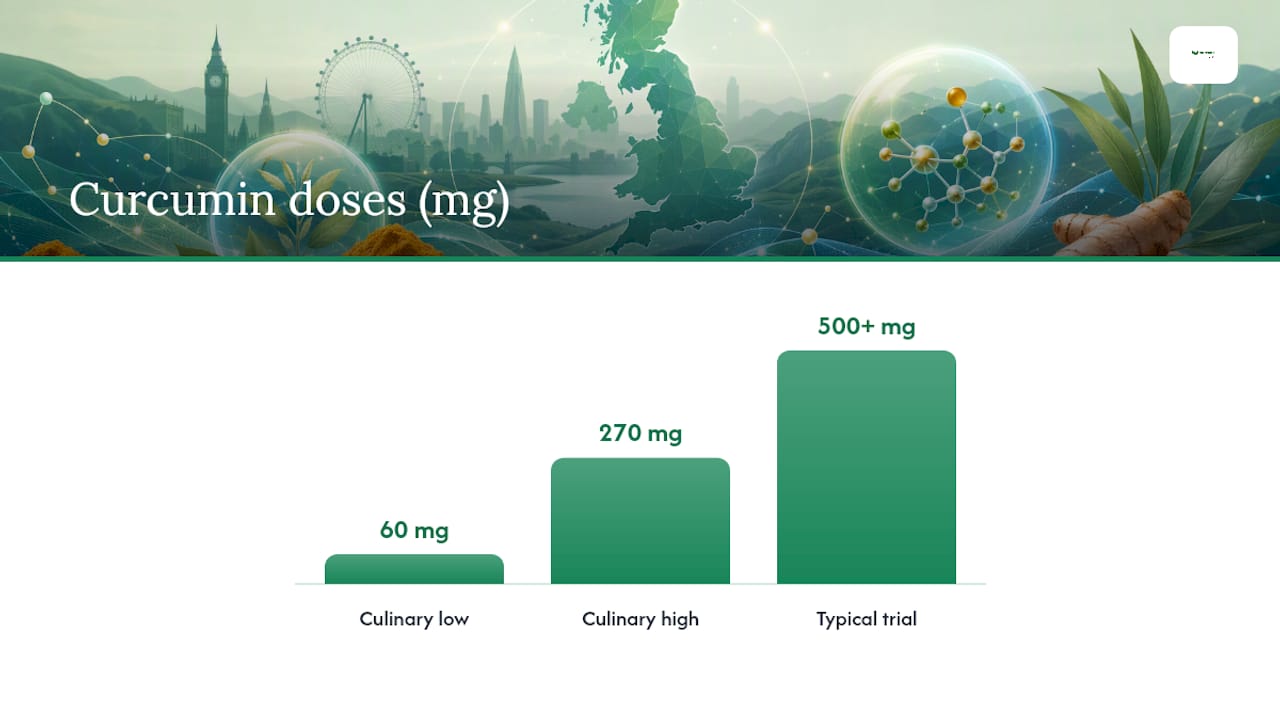
Here’s the number that changes everything: turmeric powder typically contains only about 2% to 9% curcumin by weight, according to a clinical review of turmeric and curcumin trials. A level teaspoon of turmeric weighs roughly 3 grams, so at that concentration you’re getting somewhere between 60 mg and 270 mg of curcumin, mixed in with everything else in the spice.
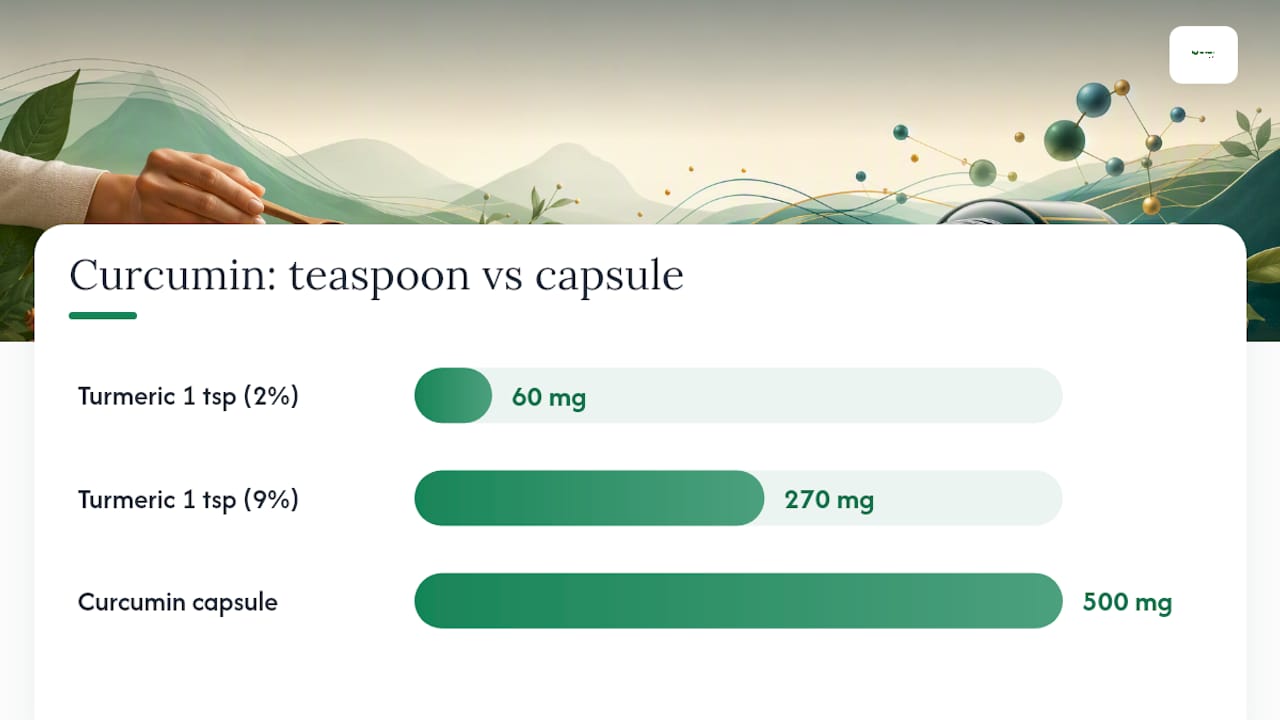
Compare that with a curcumin supplement, which isolates and concentrates the curcuminoids, often to 95% purity or higher. A single capsule can deliver 500 mg of near-pure curcumin, several times more than a generous curry portion, without any of the fibre or accompanying plant compounds.
This is exactly why the two get confused so often. People see “curcumin” on a supplement label and “turmeric” on a spice jar and assume they’re interchangeable strengths of the same thing. They’re not:
- Turmeric powder: whole rhizome, 2 to 9% curcumin, culinary use, mild everyday exposure.
- Standardised turmeric extract: concentrated rhizome extract, often boosted to a stated curcuminoid percentage, sits between spice and pure curcumin.
- Curcumin extract: isolated curcuminoids, frequently standardised to 95%, used in the doses tested in most clinical research.
- Turmeric essential oil or oleoresin: extracted compounds beyond curcuminoids, used more in flavouring and industrial applications than in supplements.
Variability matters here too. Two jars labelled “turmeric powder” from different growing regions can have noticeably different curcumin content, since soil, climate, and harvest timing all shift curcuminoid levels. That’s one reason culinary turmeric will never give you a consistent, measurable dose the way a standardised capsule can.
Do turmeric and curcumin share the same health benefits?
Both turmeric and curcumin work through the same core mechanisms: they act as antioxidants, neutralising free radicals, and they dampen inflammatory signalling. Curcumin, as the most active curcuminoid, is thought to be doing most of that heavy lifting, which is why researchers isolate it for trials rather than testing raw spice.
At the cellular level, curcumin appears to reduce inflammatory markers such as interleukin-6 (IL-6) and tumour necrosis factor-alpha (TNF-alpha), two signalling molecules that drive chronic low-grade inflammation linked to joint pain, metabolic problems, and cardiovascular strain. Turmeric’s anti-inflammatory reputation in traditional use almost certainly comes from this same pathway, just at a much lower dose per serving.
Statistic callout: Culinary turmeric typically supplies 60–270 mg of curcumin per teaspoon, against the 500 mg to multi-gram doses used in most clinical trials, a gap of roughly ten to thirty times.
Areas with supportive human research include:
- Joint comfort and stiffness, particularly in osteoarthritis, where concentrated extracts have shown measurable symptom relief.
- Metabolic markers, including some blood sugar and lipid measures in at-risk groups.
- Cardiovascular risk factors, such as markers of oxidative stress and endothelial function.
- Liver enzyme markers in a handful of smaller studies, though results are mixed.
- Skin appearance, mostly from smaller trials and topical applications rather than large oral-dose studies.
The important caveat threads through nearly all of this research: the human studies backing these benefits almost always use curcumin extracts, not culinary turmeric. A nine-month study in prediabetic adults found that a curcumin supplement group had no new diabetes diagnoses versus the placebo group, a genuinely striking result, but one built on a standardised extract at a defined dose, not on curry night.
That distinction shapes everything else in this article. Turmeric’s benefits are real but modest and diffuse, spread across a whole food matrix eaten in small amounts. Curcumin’s benefits are more concentrated and more measurable, because trials can control the exact milligram dose participants receive. If you’re eating turmeric for its flavour and general wellness contribution, you’re getting a gentle version of the same biology. If you want the effect size seen in a published trial, you generally need the extract that trial actually used.
When does curcumin extract outperform whole turmeric?
Concentrated curcumin has the strongest clinical backing in osteoarthritis, where several randomised controlled trials show measurable improvements in pain and stiffness. Trial doses vary, but a common regimen is 500 mg of curcumin twice daily, and some research using highly bioavailable formulations has found effects comparable to standard anti-inflammatory medication over a period of weeks, according to Harvard Health’s review of turmeric evidence. No amount of curry is going to replicate that, because you’d need to eat unrealistic quantities of turmeric daily to approach a 500 mg curcumin dose.
Metabolic and pre-diabetes signals are promising but still thin. The nine-month prediabetic trial mentioned earlier found zero new diabetes cases in the curcumin group compared with the placebo group, a genuinely notable result for a natural compound. But it’s a single study, and results like this need replication in larger, more diverse populations before anyone can call curcumin a preventive treatment rather than a supportive one.
Cancer research sits furthest from practical application, despite generating the most headlines. Phase I and II trials have pushed oral curcumin doses up to several grams a day and found them generally tolerable in the short term, but the Linus Pauling Institute’s review of curcumin research is blunt about the gap: systemic bioavailability stays low even at these doses, and human evidence for actual cancer prevention or treatment remains limited. Laboratory and animal studies showing curcumin slowing cancer cell growth simply haven’t translated into confirmed clinical benefit in people yet.
A few things worth weighing when you read any curcumin trial:
- Sample size: many curcumin studies involve a few dozen to a few hundred participants, smaller than the trials used to approve conventional medications.
- Formulation variability: a “curcumin” trial using a phospholipid-bound extract isn’t testing the same product as one using plain powdered curcumin, and results don’t transfer between them.
- Trial duration: joint studies often run 8 to 12 weeks; metabolic studies have run as long as nine months; most are too short to say anything about years-long use.
- Comparator: some trials compare curcumin against placebo, others against an active drug, which changes how impressive a “similar effect” result actually is.
None of this means concentrated curcumin is unproven. It means the evidence is real but specific, tied to particular formulations, doses, and conditions, rather than a blanket claim that “curcumin cures inflammation.” Treat headline claims about any single study with a healthy amount of scepticism until you’ve checked what dose and formulation it actually used.
Why does curcumin absorb so poorly, and does that change everything?
Here’s the inconvenient truth sitting underneath most curcumin marketing: plain curcumin is absorbed and eliminated from the body very quickly, and most of what you swallow leaves through digestion largely unchanged rather than entering the bloodstream. A comprehensive review of curcumin’s biological activity confirms that even high oral doses typically produce only trace plasma concentrations. This single fact explains almost every formulation innovation in the supplement industry over the past decade.
The most common fix is piperine, the compound that gives black pepper its bite. Combining curcumin with piperine can increase absorption by as much as roughly 2,000% in some study settings, according to a review of curcumin bioavailability strategies. That’s not a typo, and it’s why so many turmeric and curcumin supplements list black pepper extract on the label. Simple approaches like pairing turmeric with black pepper and a source of fat can meaningfully boost uptake even outside a lab, as this breakdown of turmeric shot absorption demonstrates for home preparations.
But piperine comes with a genuine caveat. It works partly by inhibiting enzymes that metabolise drugs in the liver and gut, the same enzymes responsible for clearing many prescription medications from your system. That’s a mechanism worth understanding fully before combining black pepper with turmeric if you’re on regular medication, since slower drug clearance can mean higher, less predictable drug levels in your blood.
Beyond piperine, formulators use several other delivery strategies:
- Phospholipid complexes (such as the branded form BCM-95) bind curcumin to fat-soluble carriers, improving absorption without relying on piperine.
- Nanoparticle or micronised curcumin reduces particle size dramatically, increasing the surface area available for absorption.
- Lipid-based carriers, including liposomal formulations, package curcumin inside fat structures the gut absorbs more readily than dry powder.
Each has trade-offs. Piperine-based formulas are usually cheaper but carry that drug-interaction caveat. Phospholipid and nanoparticle formulations tend to cost more but sidestep the enzyme-inhibition issue, making them a sensible alternative for anyone on regular medication.
Pro Tip: Don’t just check the total milligram figure on a label. A 1,000 mg “turmeric extract” with no stated delivery technology may deliver far less usable curcumin than a 250 mg dose paired with a proven absorption enhancer. Look for the specific formulation name, not just the headline number.
Practically, this means the “how much curcumin” question is less important than “how much curcumin actually reaches your bloodstream.” A cheap, high-milligram capsule with no absorption support may do considerably less than a smaller dose built on a tested delivery system.
Curcumin safety: side effects, drug interactions, and quality risks
Most people tolerate turmeric and curcumin well, and mild digestive upset, such as bloating or nausea, is the most commonly reported issue in trials at typical doses. Serious adverse effects are rare, but they cluster at the high end of dosing, particularly with long-term, concentrated supplement use rather than culinary intake.
Statistic callout: Combining curcumin with piperine can raise absorption by up to roughly 2,000% in certain trial conditions, which is exactly why that same combination needs closer scrutiny around drug metabolism.
Johns Hopkins Medicine’s clinical guidance flags that high-dose, long-term concentrated curcumin use has been linked to kidney stone risk in susceptible individuals and, in some cases, liver-related signals worth monitoring. Neither is common, but both are reasons to treat “more is better” thinking with caution.
Drug interactions deserve particular attention if you take any of the following regularly:
- Anticoagulants and antiplatelet drugs (such as warfarin or aspirin), since curcumin may have mild blood-thinning effects that compound with these medications.
- Immunosuppressants, where curcumin’s effect on inflammatory pathways could theoretically interfere with intended drug action.
- Drugs with a narrow therapeutic window, meaning small changes in blood concentration matter a lot, because piperine-enhanced curcumin can slow their clearance from the body.
Quality control is the other side of safety that gets less attention than it deserves. A review of turmeric product adulteration has documented cases of heavy metal contamination and mislabelled curcuminoid concentrations in commercial products, sometimes traced to synthetic colourants added to boost the powder’s yellow hue. Independent, batch-level testing is the only real defence against buying a product that doesn’t contain what its label claims.
If you’re scheduled for surgery, stop concentrated curcumin supplements roughly one to two weeks beforehand and mention your usage to your surgical team, given the potential blood-thinning effect. Anyone on regular prescription medication, pregnant, or managing a chronic condition like gallstones or kidney disease should speak with a clinician before starting curcumin at supplement-level doses, since the interaction risks scale with both dose and duration.
How to choose between turmeric and curcumin
The right pick comes down to a simple question: are you supporting general wellbeing, or targeting a specific symptom that clinical trials have actually tested?
- Choose culinary turmeric if your goal is general dietary variety and gentle daily antioxidant support. Cooking with the spice regularly, alongside a source of fat and some black pepper, is a reasonable low-risk habit with no need for dosing precision.
- Choose a standardised turmeric supplement if you want more than a pinch of spice but don’t need the intensity of an isolated extract. These sit between food and pharmaceutical-grade curcumin, useful for general joint support without committing to high-dose isolates.
- Choose a curcumin extract if you’re targeting a specific, evidence-backed goal, most commonly joint discomfort, and want the dose and formulation used in actual trials. This is where label details, standardisation and delivery technology, matter most.
Whatever you choose, run the label past this checklist before buying:
- Curcuminoid percentage stated clearly, ideally standardised to 95% if it’s marketed as a concentrated extract.
- Named delivery technology, such as piperine, a phospholipid complex, or micronisation, rather than a vague “enhanced absorption” claim with no mechanism given.
- Third-party testing seal or certificate of analysis, given the documented contamination risks in this category.
- Country of manufacture and batch information, so a specific lot can be traced if a quality issue ever arises.
On dosing, realistic expectations help. Culinary use delivers roughly 60 to 270 mg of curcumin per teaspoon of turmeric, spread across a meal. Most joint-focused trials use 500 mg to 1,000 mg of curcumin daily, often split into two doses, and a fair trial period to judge personal response is 8 to 12 weeks, matching the typical duration used in dosage research. Give any new regimen that full window before deciding whether it’s working.
Pro Tip: Treat any label promising huge milligram doses with no mention of delivery technology as a red flag. A 2,000 mg “turmeric complex” that never states its curcuminoid percentage or absorption method is telling you less than a well-documented 500 mg extract with a named delivery system.
Turmeric’s ancient roots and curcumin’s modern isolation
Turmeric has been used in South Asian cooking, dyeing, and traditional Ayurvedic and Chinese medicine for thousands of years, valued as a warming spice and a treatment for digestive and skin complaints long before anyone understood its chemistry. It travelled along historic spice trade routes into Middle Eastern and eventually European kitchens, prized for colour and flavour as much as any perceived health property.
Curcumin itself wasn’t chemically isolated from turmeric until the 19th century, and it took until the mid-20th century for its structure to be fully characterised by chemists. The shift from whole-spice tradition to compound-specific science accelerated sharply from the 1970s onward, as researchers began isolating curcuminoids to study them individually in laboratory settings rather than testing turmeric as a single ingredient.
That history explains the current divide neatly. Traditional use always involved the whole rhizome, fibre, oils, and curcuminoids together, consumed in food-level amounts over a lifetime. Modern research took the opposite approach: strip out one compound, concentrate it, and test it in isolation at doses far beyond what traditional diets ever provided. Both traditions have value, but they’re answering different questions, one about sustained low-level dietary exposure, the other about measurable clinical effect from a defined dose.
Whole turmeric or isolated curcumin: what the trials actually show
Head-to-head trials comparing whole turmeric against isolated curcumin at matched curcuminoid doses are relatively rare, because most researchers design studies around one form or the other rather than testing both side by side. What does exist points consistently in one direction: standardised curcumin extracts produce more measurable, replicable results than whole turmeric powder given at comparable culinary volumes.
Part of the reason is dose control. A capsule of curcumin extract delivers a known quantity every time, while turmeric powder’s curcumin content shifts with growing region, harvest, and processing, making it nearly impossible to standardise across a trial population. Researchers need that consistency to draw reliable conclusions, which is exactly why extracts dominate the clinical literature.
The other factor is simple concentration. Reaching a 500 mg curcumin dose through turmeric powder alone would require several tablespoons daily, an amount well beyond typical culinary use and difficult to sustain or standardise across participants. Trials testing turmeric powder directly, rather than extracts, tend to use smaller sample sizes and show more modest, less consistent effects.
None of this makes whole turmeric useless. It simply means the clinical evidence base was built around concentrated curcumin, and comparing “turmeric” to “curcumin” in efficacy terms is really comparing a food-level exposure to a pharmaceutical-level one. Treat claims that culinary turmeric replicates supplement-trial results with real caution, since the dose gap alone makes that an unlikely proposition.
Are turmeric and curcumin supplements regulated the same way?
Turmeric and curcumin supplements sit in a lighter regulatory category than medicines in most markets, including the UK, where they’re generally treated as food supplements rather than licensed pharmaceutical products. This means manufacturers aren’t required to prove efficacy for specific health claims before selling, unlike a prescription medication that must clear formal clinical trial phases.
That lighter regulatory touch is precisely why quality varies so widely between brands. A 2025 investigation into turmeric supplement labelling found inconsistent labelling and risky dosing practices across products sold worldwide, with some labels making milligram claims that didn’t match independent testing. Because “curcumin” gets used loosely to describe everything from raw powder to 95%-standardised extract, a milligram figure alone tells you very little without knowing the underlying formulation.
Third-party quality marks matter more here than in most supplement categories, given the documented contamination and adulteration issues already covered. Look for products tested by independent laboratories, with published certificates of analysis, rather than relying solely on front-of-pack claims. Standardisation to a stated curcuminoid percentage, ideally verified by someone other than the manufacturer, remains the clearest signal of a product that has been made and checked with any rigour.
An editorial take on the curcumin hype cycle
The gap between what curcumin promises in headlines and what the actual trial data supports is wider than most wellness content admits. Osteoarthritis relief has genuinely solid backing. Cancer prevention claims, by contrast, rest on preclinical and early-phase data that hasn’t yet translated into confirmed human benefit, and treating the two claims with equal confidence does readers a disservice.
The sensible position isn’t “curcumin doesn’t work” or “curcumin cures everything.” It’s that dose, formulation, and absorption determine outcome far more than the ingredient name on the label. A consistent, modest dose in a proven delivery format will likely serve most people better than chasing the highest milligram number on a shelf. Nu Sante Nutrition’s approach leans firmly toward that evidence-first stance: favour formulations backed by real bioavailability data, be transparent about what’s actually in a product, and resist the temptation to imply a gummy or capsule can substitute for a doctor’s advice on serious conditions.
Third-party testing shouldn’t be a premium feature reserved for expensive brands. Given how often contamination and mislabelling show up in industry reviews, independent verification deserves to be the baseline expectation for every turmeric or curcumin product on the market, not a selling point.
— Andy
Where a turmeric gummy fits between spice and extract
A daily gummy sits closer to whole turmeric than to a concentrated pharmaceutical-grade extract, and that’s exactly the point of the format. It’s built for consistency and taste, not for replicating a multi-gram clinical trial dose, which makes it a genuinely different tool from a high-strength capsule rather than a weaker version of the same thing.
Nu Sante Nutrition’s Turmeric Gummies are designed for people who want turmeric in their routine without measuring spoons of powder or choking down bitter capsules, offering a consistent daily dose in a format that’s actually easy to stick with. That consistency matters more than people assume: a supplement only helps if you keep taking it, and taste and convenience are what keep a habit going past the first week. If your goal is general daily wellbeing support and you find capsules unpleasant or easy to forget, a gummy format solves the adherence problem that derails most supplement routines.
That said, be honest about where the format’s limits sit. If you’re specifically chasing the joint-comfort outcomes seen in trials using 500 mg or more of standardised curcumin, a gummy’s curcuminoid content generally won’t match those isolated extract doses, and a dedicated high-strength capsule with a proven delivery system is the more appropriate tool. Browse the full Nu Sante Nutrition range to see which format fits your specific goal, and pick the one that matches the outcome you’re actually after.
This article is general information, not a substitute for advice from a qualified doctor. Consult a qualified healthcare professional about your own circumstances before acting on anything here.
Sources
- Role of turmeric and curcumin in prevention and treatment of chronic diseases: lessons learned from clinical trials
- Turmeric benefits: a look at the evidence — Harvard Health
- Turmeric benefits — Johns Hopkins Medicine
- Curcumin — Linus Pauling Institute, Oregon State University
FAQ
Is curcumin better than turmeric?
Neither is universally “better”, they serve different purposes. Turmeric supports general daily wellbeing through food-level curcumin exposure, while standardised curcumin extracts deliver the concentrated, trial-tested doses linked to measurable effects like joint pain relief.
What is the best source of curcumin?
Standardised curcumin extracts with a stated curcuminoid percentage and a proven delivery method, such as piperine or a phospholipid complex, offer the most reliable and absorbable source, far more concentrated than culinary turmeric powder.
What form of turmeric is best for inflammation?
For measurable anti-inflammatory effects, trial-backed curcumin extracts, often around 500 mg twice daily with an absorption enhancer, show the strongest evidence. For everyday, milder support, a turmeric gummy or standardised supplement paired with black pepper and a fat source is a reasonable daily approach.
Can turmeric cure gum disease?
No good clinical evidence supports turmeric or curcumin curing gum disease. Some smaller studies have explored curcumin’s anti-inflammatory effects on oral tissue, but this isn’t a substitute for professional dental care and treatment.