
8–12 Weeks to See Results: Turmeric and Collagen Safely Combined (UK)
Yes, most healthy adults can take turmeric and collagen together, and the combination makes physiological sense: collagen supplies the structural protein your joints and skin need, while turmeric’s curcumin calms the inflammation that breaks that protein down. The one exception is anyone on blood-thinning medication, who should check with a GP or pharmacist first. Give the pairing 8 to 12 weeks before judging results.
TL;DR:
- Doses of 10 to 20 grams of hydrolysed collagen daily are most effective for joint and skin benefits, with smaller doses showing limited impact.
- Taking curcumin with a fat source, piperine, or a formulated extract enhances absorption and its anti-inflammatory effects when used in doses of 500 to 1,000 milligrams daily.
- Both ingredients require an 8 to 12 week trial period to assess their benefits, and consistent daily use yields better results than intermittent supplementation.
- People on blood-thinning medication or managing gallbladder issues should consult healthcare providers before using turmeric supplements to avoid bleeding risks or worsening symptoms.
- Gummies offer a practical, adherence-friendly format but may require dose adjustments to match clinical trial amounts in their servings.
Table of Contents
- How collagen supports joints and skin
- How turmeric works and why absorption is the sticking point
- What the clinical evidence says about combining them
- Safety, contraindications and drug interactions
- How to take turmeric and collagen together in practice
- What to check on a label before you buy
- Why the standard advice on this pairing misses the point
- Where to find Nu Sante Nutrition’s collagen and turmeric gummies
- Sources
- FAQ
How collagen supports joints and skin
Collagen is the structural protein that holds cartilage, tendons, ligaments, and skin together. It works like scaffolding: when the body’s own collagen production slows, usually from your mid-twenties onward, that scaffolding thins and joints feel stiffer while skin loses firmness.
Not all collagen supplements do the same job. Type I dominates skin, tendons, and bone, type II is the main collagen in cartilage, and type III often works alongside type I in skin and blood vessels. Most supplements use hydrolysed collagen peptides, meaning the protein has already been broken into smaller chains so the gut can absorb it more easily than it would whole collagen. This matters because intact collagen molecules are too large to cross the gut wall efficiently.
A systematic review of collagen supplementation and joint health found that trials showing reduced joint pain and improved function in people with osteoarthritis, or in athletes, typically used 10 to 20 grams of hydrolysed collagen daily. That is a wide range, and the review notes results varied by collagen type, source, and how long people took it.
What to expect from consistent use:
- Joint comfort and mobility improvements, most commonly reported after weeks rather than days
- Skin elasticity and hydration gains, generally studied over 8 to 12 weeks
- Better results with marine or bovine hydrolysed peptides than with unprocessed gelatine
- No meaningful benefit below roughly 2.5 to 5 grams daily for skin-focused doses, or below 10 grams for joint-focused doses
Anyone weighing up sourcing should look at how marine collagen compares with bovine before choosing a product, since particle size and amino acid profile differ between the two.
How turmeric works and why absorption is the sticking point
Turmeric’s active compound, curcumin, reduces inflammation by dampening the COX-2 enzyme pathway and lowering pro-inflammatory cytokines, the signalling molecules that drive swelling and pain. It also acts as an antioxidant, neutralising free radicals that contribute to tissue damage over time. This is the mechanism behind turmeric’s anti-inflammatory reputation, and it is the reason turmeric gets studied for joint conditions rather than just used as a spice.
Clinical trials for joint pain typically use 500 to 1,000 milligrams of curcuminoids daily, a considerably higher dose than you would get from cooking with turmeric powder.
Curcumin’s bioavailability problem is well documented: on its own, very little of it reaches the bloodstream, because it is broken down quickly in the gut and liver. That single fact explains most of the confusion around turmeric dosing.
Three practical strategies improve absorption:
- Taking curcumin with a fat source, since it is fat-soluble and absorbs better alongside oils or fatty meals
- Combining it with piperine, the compound in black pepper that slows the liver’s breakdown of curcumin, though black pepper’s real-world boosting effect is often smaller than claimed
- Choosing formulated extracts engineered for higher plasma exposure, which research on curcumin bioavailability associates with better absorption than standard powder
A demonstration of turmeric shots combining fat and pepper shows how these two absorption levers work together in a practical format rather than as separate additions.
What the clinical evidence says about combining them
Direct trials testing collagen and curcumin together, in the same protocol, are scarce. Most of what exists comes from studying each ingredient separately, then reasoning about how they might complement each other. That is an honest limitation worth stating upfront, but it does not mean the pairing lacks a scientific basis.
The evidence for each ingredient alone is solid enough to make the combination logical rather than speculative.
- Collagen: the PMC systematic review covering osteoarthritis patients and athletic populations reports reduced pain and improved function, largely at 10 to 20 grams daily of hydrolysed peptides
- Curcumin: a review of curcumin for osteoarthritis found it can reduce pain and stiffness, and in some trials performs comparably with NSAIDs for knee pain, generally with fewer gastrointestinal side effects
- Mechanistic link: preclinical research on wound models shows curcumin can upregulate type I collagen gene expression, meaning it may support the body’s own collagen production process rather than just protecting existing tissue
- Broader literature: additional trial records on PubMed confirm the depth of research on each ingredient individually, while underlining how heterogeneous and limited the combined-use data still is
Collagen supplies the structural amino acids joints and skin are built from. Turmeric changes the inflammatory environment those tissues sit in. Neither one replaces mechanical loading, physiotherapy, or a GP’s advice for a genuine joint problem, and the trial evidence for each ingredient makes that division of labour clear even without a study testing them side by side.
The practical takeaway is one of complementary roles rather than interchangeable ones. Collagen provides raw material; curcumin can lower the inflammatory background that would otherwise degrade that material faster than the body can replace it. Curcumin’s comparable performance to NSAIDs for some measures of knee pain, alongside a lower risk of gastrointestinal harm reported in the same review, makes it a reasonable option for people who cannot tolerate regular anti-inflammatory painkillers.
Set your expectations around a realistic timeframe. Most trial protocols for both ingredients run 8 to 12 weeks before measuring outcomes, a window echoed across multiple clinical timelines. Nothing in the evidence suggests either ingredient works as a substitute for exercise, physiotherapy, or seeing a doctor about persistent joint pain. Think of turmeric and collagen as support for a broader routine, not a stand-alone fix.
Safety, contraindications and drug interactions
The single most important caution applies to anyone taking blood-thinning medication. Curcumin has mild anticoagulant properties, and Welsh NHS medicines guidance advises people on warfarin, DOACs, aspirin, or other anticoagulant and antiplatelet drugs to speak to a healthcare provider before starting turmeric. Combining the two can increase bleeding risk, and that risk is not one to guess your way around.
Other groups need to think carefully too:
- Gallbladder disease. Curcumin stimulates bile production, which can worsen symptoms in people with gallstones or bile duct obstruction.
- Pregnancy and breastfeeding. Therapeutic-dose curcumin supplements have not been well studied in this group, so food-level turmeric is a different matter from concentrated extracts.
- High-dose gastrointestinal upset. A safety profile review of curcumin found both ingredients generally well tolerated at recommended doses, though curcumin occasionally causes mild stomach upset, nausea, or diarrhoea at higher doses.
- Kidney disease and collagen. Collagen is a protein source, so anyone managing kidney disease under medical protein restrictions should discuss total protein load with their clinician before adding 10 to 20 grams daily.
- Pre-surgery timing. Because of the anticoagulant effect, curcumin is often flagged for discontinuation before planned surgery, on the same logic as other blood-thinning supplements.
Pro Tip: Write down every medicine and supplement you take, including over-the-counter painkillers, before your next GP or pharmacist appointment. Anticoagulant interactions are the one area here where guesswork genuinely is not worth the risk.
Beyond medication interactions, both ingredients have a good general tolerance record. Start with the lower end of the dose range for the first week, watch for stomach upset or unusual bruising, and stop the turmeric component specifically if either appears. Collagen rarely causes side effects beyond mild digestive fullness at higher doses, since it is, after all, simply a protein.
How to take turmeric and collagen together in practice
Getting the dosing and timing right matters more than which brand you choose. Here is a routine that respects both the absorption science and real-world habits.
- Pick your ranges. Aim for 10 to 20 grams of hydrolysed collagen daily and 500 to 1,000 milligrams of curcuminoids, adjusting toward the lower end when starting out.
- Decide on timing. Take curcumin with a meal containing some fat, since that is when absorption improves most; collagen is flexible and works on an empty stomach or with food.
- Combine or separate. You can take both with the same meal for simplicity, or take collagen first thing and curcumin with lunch or dinner, whichever fits your routine better.
- Track your response. Give the combination a genuine 8 to 12 week trial before deciding whether it is working, rather than judging after a week or two.
A few practical notes worth weighing before you commit to a format:
- Powders and capsules let you hit precise clinical doses, which gummies generally cannot match gram-for-gram
- Gummies improve consistency for people who forget capsules, trading some dosing precision for daily adherence
- Both ingredients survive gentle heat well, so cooking them into food is a legitimate delivery method
Two simple ways to combine them at home: a golden milk stirred with a scoop of collagen peptides, using warm milk, turmeric, a pinch of black pepper, and a splash of oil for absorption; or a post-workout smoothie blending collagen powder, a small amount of turmeric, a spoon of nut butter or half an avocado for the fat, and your usual fruit base. Both routes tick the fat-and-timing boxes the evidence points to, and both fit into an existing meal rather than adding a separate ritual. For more structured timing ideas, when to take collagen and UK turmeric dosage guidance cover the finer scheduling details.
What to check on a label before you buy
Not every product delivers what the trials tested. Look for standardised curcuminoid content on the label, ideally stating the milligrams of actual curcuminoids rather than just “turmeric extract,” since that figure tells you whether a serving gets close to the 500 to 1,000 milligram range used in studies. A mention of piperine or a named bioavailability-enhancing formulation is a second marker worth checking, alongside hydrolysed collagen peptides rather than unspecified “collagen” on a collagen product.
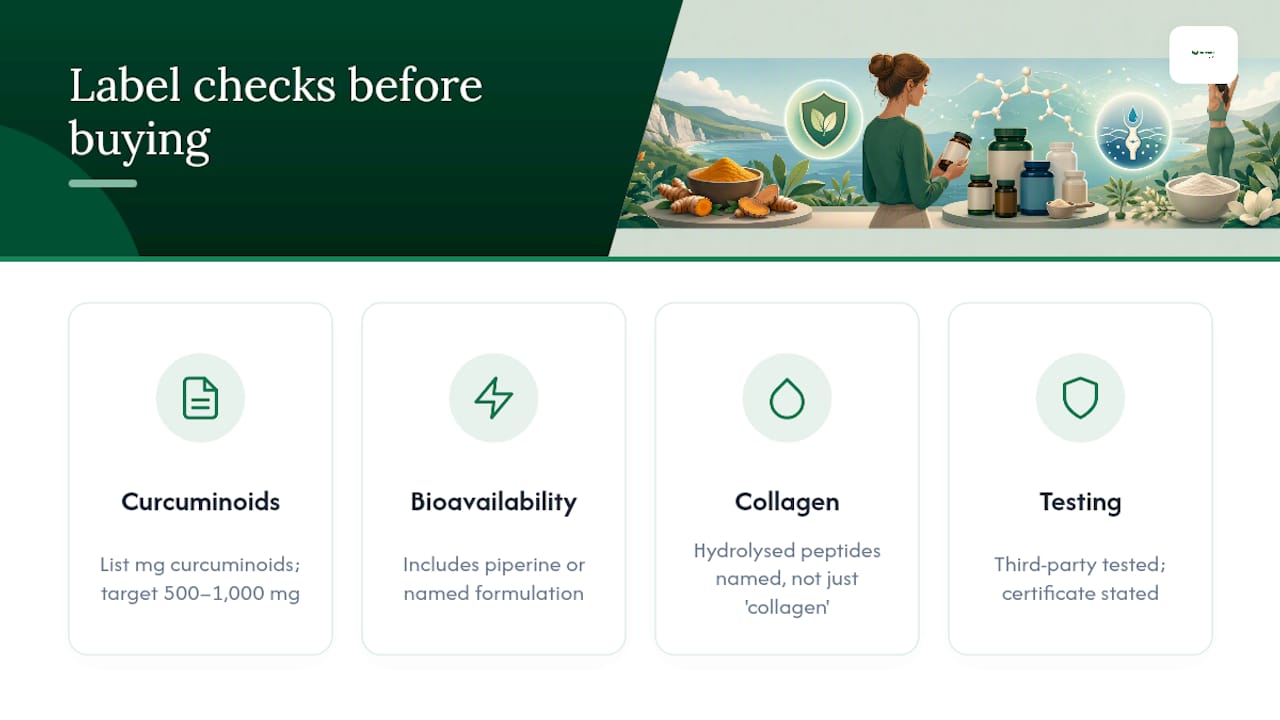
Third-party testing matters too, since it confirms a product contains what the label claims and nothing it should not.
A certain brand builds its Turmeric Gummies and Collagen Gummies around this same logic: convenience without abandoning the label transparency that evidence-based supplementation depends on. For busy people, adherence tends to be the real deciding factor in whether a supplement works at all, and a format you actually remember to take daily beats a technically superior powder gathering dust in a cupboard. Gummies will not always hit clinical gram-for-gram doses in a single serving, so check the per-serving figures and adjust serving size accordingly rather than assuming one gummy equals one clinical dose.
Why the standard advice on this pairing misses the point
Most guidance on turmeric and collagen treats them as two separate wellness trends rather than asking whether they actually work together, and that framing does readers a disservice. The evidence, read honestly, supports a fairly narrow but useful claim: collagen rebuilds, curcumin protects what is being rebuilt from excess inflammatory damage. That is not a dramatic story, and it will not fix a torn ligament or replace physiotherapy, but it is a defensible one.
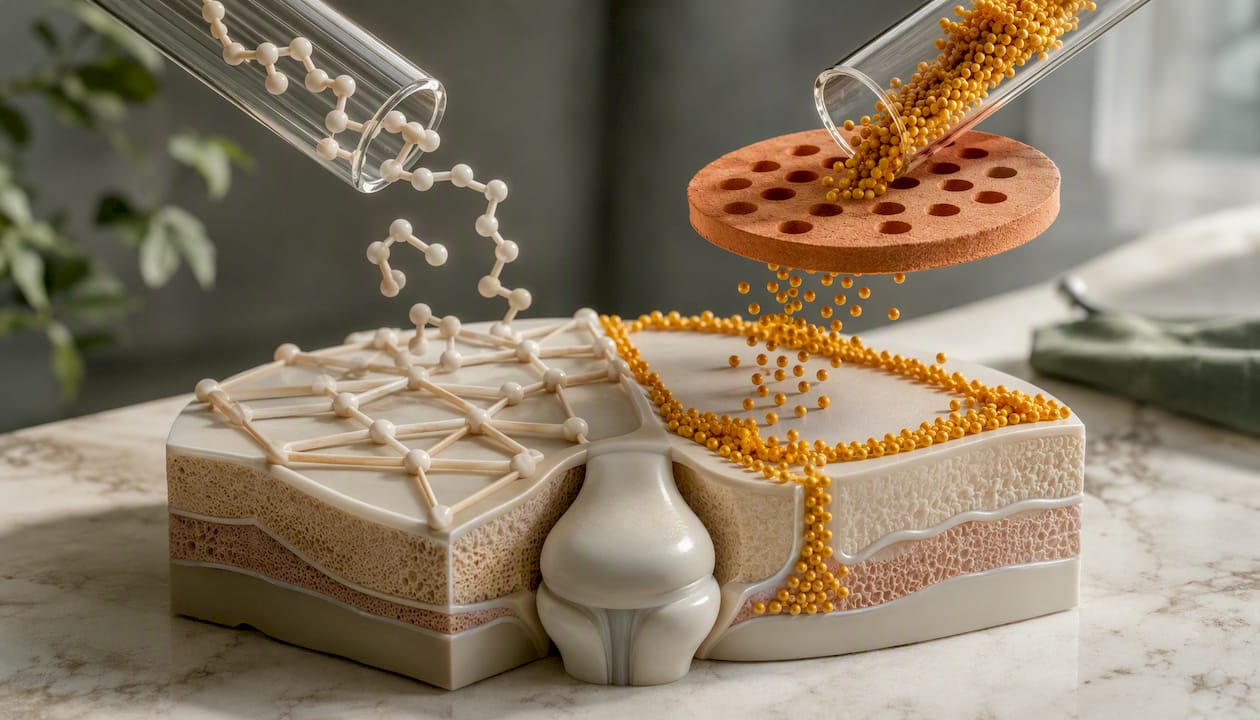
Where conventional advice falls short is bioavailability. Plenty of turmeric products get sold and bought without any acknowledgement that curcumin barely absorbs on its own. If a label does not mention fat, piperine, or a bioavailability-enhancing formulation, the dose on the front of the packet is close to meaningless.
Prioritise absorption science over dose size, and prioritise consistency over intensity. A modest daily routine followed for 12 weeks will outperform an aggressive one abandoned after ten days, every time.
— Andy
Where to find Nu Sante Nutrition’s collagen and turmeric gummies
If capsules and powders have never stuck as a habit, a gummy format may offer an alternative option designed to close this gap. Rather than juggling separate tubs and remembering fasted-versus-fed timing rules, you get Collagen Gummies and Turmeric Gummies formulated for daily use, with the taste and format that make skipping a day less likely.
Gummies do involve a trade-off worth being upfront about: matching a clinical-trial dose of 10 to 20 grams of collagen or 500 to 1,000 milligrams of curcuminoids may mean checking the per-serving figures and adjusting how many you take, rather than assuming one gummy covers a full research dose. That is a small amount of label-reading in exchange for a format you will actually stick with for the 8 to 12 weeks that matter.
Full ingredient lists, curcuminoid content, and testing details for both ranges sit on the Nu Sante Nutrition product pages, where you can compare the full gummy line-up before ordering. If you take blood thinners or manage a chronic condition, talk to your GP or pharmacist before adding turmeric to your routine, whichever format you choose.
This article is general information, not a substitute for advice from a qualified doctor. Consult a qualified healthcare professional about your own circumstances before acting on anything here.
Sources
- Turmeric: potential interactions – Welsh NHS (WMIC)
- Systematic review: Collagen supplementation and joint health (PMC10058045)
FAQ
Can you mix turmeric with collagen?
Yes, for most healthy adults. Curcumin’s anti-inflammatory action and collagen’s structural role work through different mechanisms, so there is no known negative interaction between the two.
What should not be taken together with collagen?
Collagen itself has few interaction risks, but people with kidney disease on protein restrictions should discuss total daily protein intake, including collagen, with their clinician before adding 10 to 20 grams daily.
What supplements should not be taken with turmeric?
Turmeric requires caution alongside blood-thinning medication such as warfarin, DOACs, or aspirin, since curcumin has mild anticoagulant properties that can compound bleeding risk.
Which is better for joint pain, collagen or turmeric?
They address different parts of the problem rather than competing directly. Collagen supplies the structural protein cartilage needs, while curcumin reduces the inflammation that causes pain, so many people find using both gives a more complete result than either alone.