

Turmeric for skin: do gummies actually work?
Ingestible turmeric gummies can support skin health for most people, provided the formulation delivers curcuminoids at a clinically relevant dose with a bioavailability-enhancing technology. A double-blind, placebo-controlled trial found measurable improvements in skin hydration from day 15 and a statistically significant reduction in blemish scores from day 30 with a 250 mg daily oral turmeric extract. The main caveat: not all gummies are equal. Absorption varies considerably by formulation, so the label matters as much as the ingredient.
A gummy that lists only “turmeric root powder” with no extract standardisation is unlikely to deliver a meaningful dose.*
Key takeaways
Pectin-based turmeric gummies with a standardised curcuminoid extract and a named bioavailability technology can support skin hydration and blemish reduction, with measurable changes typically appearing from day 15 and day 30 respectively in controlled trials.
| Point | Details |
|---|---|
| Clinical evidence exists | Small human trials show hydration improvements from day 15 and blemish reduction from day 30. |
| Gummies can match capsules | Pectin gummies were bioequivalent to capsules for curcuminoid absorption in a controlled crossover trial. |
| Formulation is critical | Look for a standardised extract and a named bioavailability technology on the label. |
| Safety check needed | Consult a GP or pharmacist if you take anticoagulants, are pregnant, or are breastfeeding. |
| Nu Sante Nutrition | Turmeric Gummies available in the UK; check the product page for ingredient and testing details. |
Table of Contents
- How does curcumin from turmeric support skin health?
- What do human trials actually show about oral curcumin and skin?
- Do gummy formats actually absorb as well as capsules?
- Safety, side effects and drug interactions (UK context)
- How to pick a turmeric gummy for skin health in the UK
- When to take turmeric gummies and what results to expect
- Nu Sante turmeric gummies: a convenient UK option
- A note from the Nu Sante wellness team
- Nu Sante Nutrition: turmeric gummies for UK shoppers
- Sources
How does curcumin from turmeric support skin health?
Curcumin, the active compound in turmeric, supports skin through two main pathways: reducing inflammation and protecting cells from oxidative damage. A controlled human study confirmed that oral curcumin increased expression of cytoprotective genes in skin tissue, including NQO1 at roughly 3.3-fold, via the Keap1-Nrf2-ARE pathway, and reduced inflammatory cytokine gene expression including IL-1β and TNF-α.
The key mechanisms relevant to skin:
- Anti-inflammatory action. Curcumin modulates pro-inflammatory cytokines (TNF-α, IL-1β), which are linked to redness, blemishes and barrier disruption.
- Antioxidant enzyme induction. Activation of Nrf2 upregulates protective enzymes (NQO1, HO-1) that reduce oxidative damage in skin cells.
- Collagen and wound-healing support. Preclinical and small clinical data suggest curcumin can support collagen deposition and tissue repair, relevant to skin structure and firmness.
- Barrier and hydration effects. Reduced inflammation at the cellular level may support the skin’s moisture barrier over time.
Mechanism in brief: oral curcumin reaches skin tissue, activates protective gene pathways, and dials down inflammatory signals. The visible result, over weeks, is calmer, better-hydrated skin.
For these effects to occur systemically, curcuminoids must reach meaningful plasma concentrations after oral dosing. That is where formulation becomes critical.
What do human trials actually show about oral curcumin and skin?
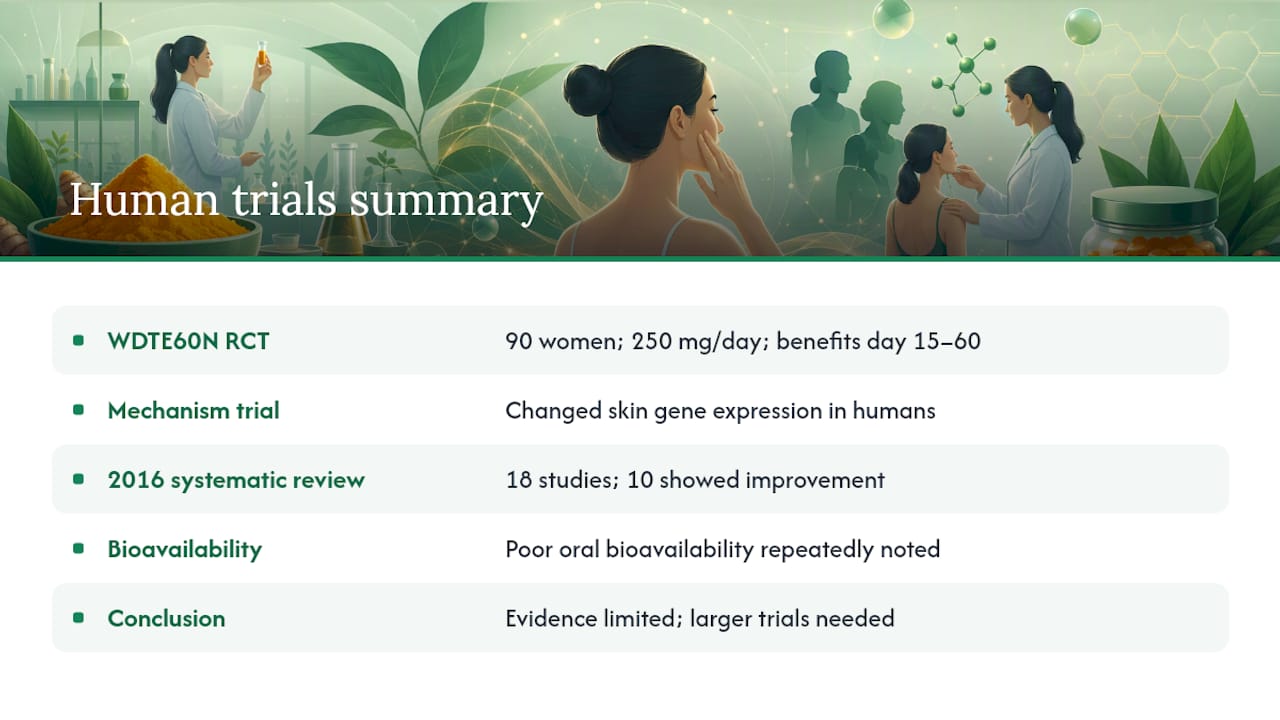
The most directly relevant trial is the WDTE60N study: 90 healthy women completing a 60-day, randomised, double-blind protocol with 250 mg of a water-dispersible turmeric extract daily. Hydration and skin gloss improved from day 15; blemish scores fell significantly from day 30 and the improvement was sustained through day 60.
A separate mechanism trial confirmed that oral curcumin produces measurable changes in skin gene expression in humans, not just in cell cultures, which gives the clinical observations a plausible biological basis.
A 2016 systematic review identified 18 eligible human studies (9 involving ingestion, 8 topical, 1 combined), with 10 reporting statistically significant improvements in skin disease severity. The authors noted that studies were small and heterogeneous, a limitation that still applies.
“Both ingested and topical turmeric/curcumin interventions showed statistically significant improvements in skin disease severity in the majority of studies reviewed, though all were limited by small sample sizes.” Systematic review, PubMed, 2016
A comprehensive review confirmed curcumin’s anti-inflammatory, antioxidant and wound-healing potential across multiple skin conditions while emphasising that poor oral bioavailability remains a recurring limitation. Larger, well-powered trials are still needed before strong clinical claims can be made.
Do gummy formats actually absorb as well as capsules?
Bioavailability determines whether curcuminoids reach skin-relevant tissues in sufficient concentrations. A randomised, crossover clinical trial tested the same dried colloidal turmeric suspension (Turmipure Gold®) across multiple food matrices and found that pectin gummies were bioequivalent to capsules for total curcuminoid exposure (AUC24h), while lipid-containing matrices outperformed both.
Key findings from that trial:
- Dairy analogue (oat milk) notably increased dose-normalised AUC24h compared to capsule.
- Sports bar and a probiotic drink also increased dose-normalised AUC24h compared to capsule.
- Pectin gummies matched capsules, countering the assumption that gummies are always less effective.
- Liquid matrices shortened time to peak plasma concentration (Tmax) by 41–46%, meaning faster uptake.
This Clinicaltrials (NCT06300021) included a pectin gummy arm with 300 mg Turmipure Gold® per serving, confirming the food-matrix approach has been prospectively studied in humans.
A NutraIngredients summary of the Food & Function findings highlighted that polar lipids in dairy analogues drive the absorption advantage, and that taking a gummy alongside a small fat-containing snack may replicate some of that benefit.
Other formulation technologies that improve curcuminoid uptake include lecithin complexation, nanoemulsions, and piperine co-administration. A 2023 review mapped these delivery systems against skin outcomes and identified liposomes and nanoemulsions as particularly promising for systemic delivery.
Safety, side effects and drug interactions (UK context)
Curcumin is generally well tolerated at typical supplement doses, but it has known interactions and specific cautions worth checking before you start.
Common mild side effects at standard doses include gastrointestinal discomfort, nausea and loose stools, particularly on an empty stomach. The WDTE60N trial reported no serious adverse events at 250 mg daily over 60 days.
Drug interactions to be aware of:
- Anticoagulants and antiplatelet drugs (e.g. warfarin, aspirin, clopidogrel): curcumin has antiplatelet properties and may increase bleeding risk.
- Chemotherapy agents: curcumin can interact with CYP450 enzymes and P-glycoprotein, potentially affecting drug metabolism.
- Diabetes medications: curcumin may have additive blood-glucose-lowering effects.
- Iron absorption: high doses may reduce non-haem iron absorption.
For guidance on supplementation during pregnancy, the collagen during pregnancy guide covers relevant safety principles that apply to supplement use more broadly. Turmeric supplements are not recommended during pregnancy or breastfeeding without medical supervision.
How to pick a turmeric gummy for skin health in the UK
The single most important label check is a standardised curcuminoid dose per serving combined with a named bioavailability technology. Without both, there is no way to assess whether the product will deliver a clinically relevant amount.
| Label check | What to look for |
|---|---|
| Curcuminoid dose per serving | 250–500 mg of a standardised extract |
| Standardisation level | standardised curcuminoid content stated on label |
| Bioavailability technology | Lecithin complexation, colloidal suspension, nanoemulsion, or piperine |
| Gummy base | Pectin (vegan/vegetarian-suitable) vs gelatin |
| Sugar and alcohol content | Check per-serving sugar; avoid if managing blood glucose |
| Third-party testing | UK lab certificate or independent COA available |
| Allergen and vegetarian labelling | Clearly stated on pack or product page |
For a curated shortlist of options meeting these criteria, the best turmeric gummies UK guide covers formulation differences in detail.
Pro Tip: Ask the brand directly for a Certificate of Analysis (COA) from a UK-accredited laboratory. Reputable brands provide this on request or publish it on their product page. If a brand cannot supply one, that is a reason to look elsewhere.
When to take turmeric gummies and what results to expect
Take turmeric gummies with a meal containing some fat unless the gummy formulation already includes a lipid-based delivery system. The fat co-administration supports curcuminoid absorption, as the food-matrix trial data confirms.
Realistic timeline based on clinical data:
- Days 1–14. No visible changes expected. Curcuminoids are building systemic exposure; consistent daily dosing is the priority.
- Day 15 onwards. Hydration and skin gloss improvements were measurable from this point in the WDTE60N trial.
- Day 30 onwards. Statistically significant blemish score reductions were observed from day 30 in the same trial.
- Weeks 8–12. Fuller anti-inflammatory benefits and more sustained skin changes are more likely with consistent use over this period.
Human trials used doses in the range of 250–500 mg of standardised extract daily. Always follow the labelled instructions for the specific product you purchase, and seek medical advice if you have an existing skin condition or are on medication.
Nu Sante turmeric gummies: a convenient UK option
Nu Sante Nutrition’s Turmeric Gummies are formulated for UK shoppers who want a straightforward, daily beauty-from-within supplement without switching to capsules or powders.
| Product detail | Nu Sante Turmeric Gummies |
|---|---|
| Format | Pectin-based gummy |
| Suitability | Vegetarian-friendly |
| Intended use | Daily skin health and general wellbeing support |
| Where to buy | Nu Sante Nutrition online store |
Full ingredient details, curcuminoid content per serving, and any available lab certificates are listed on the product page. Check the product page directly for the current formulation specification and third-party testing information before purchasing.
A note from the Nu Sante wellness team
The evidence for oral turmeric and skin health is real, but it is also specific: the right extract, at the right dose, in a format that actually absorbs. At Nu Sante Nutrition, the focus is on gummies that are both convenient and formulated with verified ingredients, because a supplement you actually take every day will always outperform one you forget or find unpleasant.
Consistency matters more than most people expect. The clinical data shows that meaningful skin changes take at least 30 days, and the full benefit builds over weeks of regular use. A gummy that fits easily into a morning routine removes the main barrier to that consistency.
For personal medical advice, particularly if you are on prescribed medication or have a diagnosed skin condition, consult your GP or pharmacist before starting any new supplement.
Nu Sante Nutrition: turmeric gummies for UK shoppers
Capsules work. Powders work. But neither fits easily into a busy morning. Nu Sante Nutrition’s Turmeric Gummies give you a daily curcumin supplement in a format that takes seconds, tastes good, and removes the friction that causes most people to stop taking supplements within a few weeks.
The clinical data in this guide shows that consistent daily dosing over 30 or more days is what produces visible skin changes. A gummy you actually look forward to taking is the most practical way to hit that consistency target. Nu Sante Nutrition ships across the UK, and the full ingredient list, serving details and any available lab certificates are on the product page.
View Nu Sante Turmeric Gummies and check the label details before you buy.
This article is general information, not a substitute for advice from a qualified doctor. Consult a qualified healthcare professional about your own circumstances before acting on anything here.
Sources
- The influence of food matrices on the bioavailability of curcuminoids from a dried colloidal turmeric suspension: a randomised, crossover, clinical trial - Food & Function (RSC Publishing)
- Efficacy and Safety of an Oral Low‑Dose Water‑Dispersible Turmeric Extract Capsule on Facial Skin Health in Healthy Women: A Randomized, Double‑Blind, Placebo‑Controlled Trial - PMC
- Oral glucoraphanin and curcumin supplements modulate key cytoprotective enzymes in the skin of healthy human subjects: A randomized trial - MDPI
- Clinicaltrials
- Study provides insights into enhancing curcumin absorption - NutraIngredients