
UK mushroom gummies dosage: Aim for 500–1,500 mg and check extract ratios
Aim for the labelled serving that delivers 500–1,500 mg of mushroom extract daily for reishi or cordyceps, and closer to 1,000 mg or more for lion’s mane where trials give a clearer target. Work out your daily total by multiplying mg per gummy by the number of gummies you take. Start with the lowest labelled serving and give it 30 to 60 days before judging whether it’s working.
TL;DR:
- Most consumer gummies target 500 to 1,500 mg of mushroom extract daily, but lion’s mane has a well-researched range of 1,000 to 3,000 mg per day; gummies often use concentrated extracts to meet this dosage.
- Reishi’s clinical doses vary widely, with daily wellness use typically falling between 500 to 1,500 mg, which is below the amounts used in medical studies; extract ratio and active markers matter more than total weight.
- Gummy absorption is comparable to capsules if doses and extract concentrations match, but gummies usually contain less mushroom extract per serving due to formulation volume and taste considerations.
- For best results, start with the lowest labeled dose for at least 30 days, extend to 60 days for cognitive or endurance goals, and track obvious metrics like focus and energy to evaluate effectiveness.
- Pregnant, breastfeeding, children, or individuals on blood thinners or immunosuppressants should consult healthcare professionals before using mushroom gummies, due to limited safety data and potential drug interactions.
Table of Contents
- Mushroom gummies dosage by type: lion’s mane, reishi and cordyceps
- How to read a mushroom gummy label and work out your daily dose
- Safety, side effects and drug interactions to check first
- Running a 30 to 60 day trial to see if it’s working
- Dosage adjustments for children, older adults, and pregnant or breastfeeding people
- Does gummy form absorb differently to capsules or powders?
- When is the best time of day for mushroom gummies?
- Does storage affect potency and dosage accuracy?
- Andy’s take: how Nu Sante Nutrition approaches dosing and labelling
- Nusante mushroom gummies: a practical fit for daily dosing
- Sources
- FAQ
Mushroom gummies dosage by type: lion’s mane, reishi and cordyceps
Not every mushroom in your gummy jar has the same weight of evidence behind it, and that matters more than most labels let on.
Lion’s mane is the one you can dose with real confidence. Human trials have used roughly 1,000 to 3,000 mg per day of fruiting body powder, with a widely cited 2009 trial using 1,000 mg daily and reporting cognitive benefits. That’s a genuine research-backed range, which puts lion’s mane ahead of reishi and cordyceps for dosing certainty. If your gummy uses a concentrated extract rather than raw powder, a smaller mg figure can still deliver an equivalent dose. Check the extract ratio before assuming a lower number means a weaker product.
Reishi is trickier. Research doses swing wildly depending on the study population, from a few hundred milligrams up to several grams a day, and one trial using a polysaccharide extract gave 1,800 mg three times daily to cancer patients without clear group-level immune improvements. That’s not a number to copy for daily wellness use. It’s a clinical dose in a specific medical context, not a consumer target. For everyday gummies, a practical range of 500 to 1,500 mg daily is more sensible, and following a transparent, extract-based label matters more than chasing gram-level doses.
Cordyceps sits somewhere in between. Endurance studies commonly use 2 to 3 grams per day of standardised extract over 6 to 12 weeks, and shorter or lower-dose trials tend to show little effect. Most consumer gummies land at 500 to 1,500 mg daily for general energy support, well below trial amounts, which is fine for everyday use but worth knowing if you’re expecting trial-level performance gains.
- Lion’s mane: 1,000–3,000 mg/day of fruiting body powder in trials; gummies may use concentrated extracts at lower mg
- Reishi: research doses range from hundreds of mg to several grams; consumer gummies typically target 500–1,500 mg/day
- Cordyceps: endurance trials use 2–3 g/day; consumer gummy targets usually sit at 500–1,500 mg/day
Pro Tip: A 10:1 extract means 100 mg of extract is roughly equivalent to 1,000 mg of raw mushroom material. Always check whether a label’s mg figure refers to the extract or the raw biomass before comparing products.
How to read a mushroom gummy label and work out your daily dose
Most labels give you three or four numbers. Only some of them tell you anything useful.
- Find the mg of mushroom extract per gummy and the serving size. Multiply that mg figure by the number of gummies in a serving to get your daily total. A 250 mg gummy taken twice daily gives you 500 mg, not 250 mg.
- Check the extract ratio and whether it names fruiting body or mycelium. Fruiting body extracts generally carry higher concentrations of the studied bioactives than mycelium grown on grain, which can dilute the active content per gram.
- Look for standardised actives such as beta-glucans or triterpenes. These markers tell you what’s actually biologically active in the product, rather than just the total weight of mushroom material used.
- Prefer products that state an active-marker percentage or extract strength. If a label gives you only a total mg figure with no ratio and no active markers, treat that number as far less informative than it looks.
A “500 mg mushroom blend” spread across five species often works out to roughly 100 mg of each species, frequently below any clinical threshold. Multi-species blends can look generous on the front of the pack while delivering very little of any single mushroom. For a closer look at what separates a genuinely transparent product from a vague one, check the label carefully before you buy.
Safety, side effects and drug interactions to check first
Functional mushrooms are generally well tolerated, but “generally” isn’t “always.”
The most common issues are mild: digestive upset, bloating, or an allergic reaction in people sensitive to fungi. Stop taking the gummies and speak to a pharmacist or doctor if you notice a rash, swelling, or persistent stomach discomfort after starting a new product.
Interactions are the bigger concern for specific groups. Reishi and cordyceps may affect blood clotting, so anyone taking anticoagulant or antiplatelet medication should check with a clinician first. Reishi’s immune-modulating effects also raise questions for people on immunosuppressant drugs, where a supplement working against the medication’s purpose is a real risk. Pregnant or breastfeeding people should avoid starting any functional mushroom supplement without medical advice, since safety data for these groups is limited.
- Digestive upset or allergic reaction: discontinue use and seek advice if symptoms persist
- Anticoagulant or antiplatelet medication: check with a clinician before adding reishi or cordyceps
- Immunosuppressant therapy: reishi’s immune effects may interfere with treatment
- Pregnancy or breastfeeding: avoid starting without professional guidance
Third-party testing matters here too. A product tested by an independent lab for contaminants and active-marker content gives you a safety net a bare ingredient list doesn’t. If something feels off after starting a new supplement, report it to your GP or pharmacist rather than assuming it will pass.
Running a 30 to 60 day trial to see if it’s working
Functional mushroom benefits build gradually, not overnight, so a short trial rarely tells you anything useful.
- Start with the lowest labelled serving for at least 30 days. This gives your body time to adjust and gives you a fair baseline before judging the effect.
- Extend to 60 days for cognitive or endurance goals. Lion’s mane’s cognitive effects and cordyceps’ endurance benefits both tend to build over weeks rather than days.
- If nothing changes, check the extract concentration first. A weak or poorly standardised product may need a higher dose within label guidance, or a switch to one with clearer active-marker content.
- Track a few simple metrics daily. A short journal noting energy, focus, sleep quality, and how often you catch a cold or infection gives you something concrete to review after 30 days, rather than relying on vague impressions.
- Be cautious about stacking multiple mushroom blends. Unless you know the total mg and active content of each mushroom in the mix, layering products makes it impossible to tell what’s actually contributing to any change you notice.
Dosage adjustments for children, older adults, and pregnant or breastfeeding people
Standard mushroom gummy dosing is built around healthy adults, which means several groups need a different approach entirely.
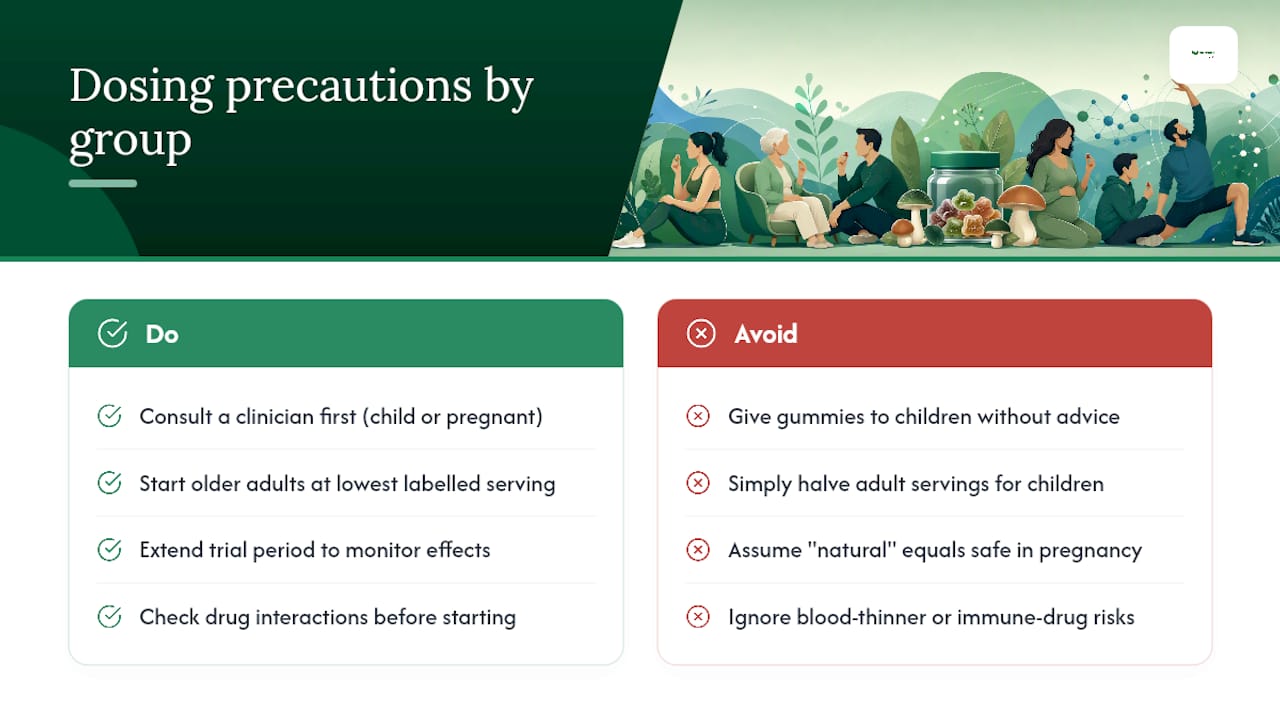
Children aren’t included in the clinical trials that inform lion’s mane, reishi, or cordyceps dosing, so there’s no reliable mg range to recommend for them. Functional mushroom gummies aren’t formulated or tested for children, and a parent considering one for a child should speak to a paediatrician first rather than simply halving an adult serving.
Older adults can generally use adult dosing ranges, but age often comes with more medications, and that raises the odds of an interaction, particularly with blood thinners or immune-modulating drugs. Starting at the lowest labelled serving and extending the trial period gives more room to notice any adverse response before increasing intake.
Pregnant or breastfeeding people fall into the same category as children here: safety data is limited across all three mushroom types discussed in this guide. That’s not the same as proof of harm, but it’s reason enough to treat any functional mushroom supplement as something to discuss with a midwife or doctor before starting, rather than assuming a “natural” label means automatically safe. This caution applies as much to reishi and cordyceps as it does to lion’s mane, since none of the three have been studied in pregnancy or lactation.
Does gummy form absorb differently to capsules or powders?
Gummies work through the same digestive pathway as capsules and powders, so the mushroom compounds themselves aren’t absorbed differently just because they’re in a chewable format.
What changes is what happens before digestion even starts. A gummy is chewed and partially broken down in the mouth, which can support slightly faster initial breakdown compared with swallowing a capsule whole. Capsules rely entirely on stomach acid and enzymes to dissolve the shell before the contents become available, which can take longer, particularly with harder-shelled capsule types.
Where gummies can lose ground is extract concentration per dose. Because gummies need sugar, gelatine or pectin, and flavouring to hold their shape and taste, they typically carry less mushroom extract per unit than a capsule or a loose powder scoop, which is why gummy serving sizes often ask for two or three units rather than one. This isn’t a bioavailability problem so much as a volume one: you’re simply fitting less active material into a chewable format designed to taste good.
The upshot is practical rather than pharmacological. If a gummy and a capsule use the same extract and dose, the total absorbed will be broadly comparable, but you may need to check the label more carefully to confirm the gummy actually matches the capsule’s mg per serving.
When is the best time of day for mushroom gummies?
There’s no single correct time, but the mushroom type and your goal both point in useful directions.
Lion’s mane and cordyceps, taken for focus or energy, tend to suit a morning or early afternoon dose, similar to how you’d time a coffee. Taking either too late in the day risks mild alertness effects interfering with sleep, though this varies by person and dose.
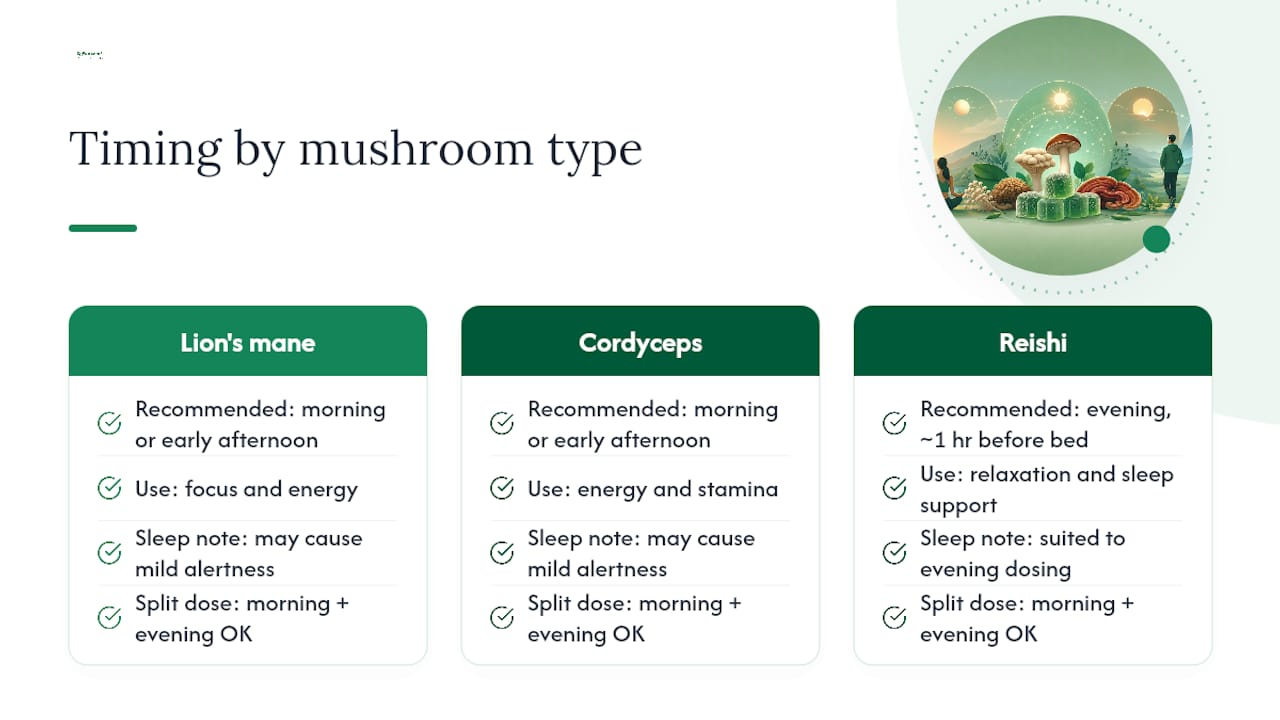
Reishi is the opposite case. It’s often used for relaxation and sleep support, so an evening dose, roughly an hour before bed, tends to fit its intended use better than a morning one.
If you’re taking more than one gummy in your daily serving, splitting the dose, one in the morning and one in the evening, can help maintain steadier levels through the day rather than one large dose all at once. Consistency in timing matters more than the exact hour you choose. Taking your gummy at roughly the same time each day makes it easier to notice a genuine change over your 30 to 60 day trial, rather than mistaking day-to-day variation for a real effect.
Does storage affect potency and dosage accuracy?
Yes, and this is one of the most overlooked variables in getting an accurate daily dose from a gummy.
Heat, humidity and direct sunlight can all degrade the active compounds in a mushroom extract over time, meaning a gummy stored on a warm windowsill for months may deliver less than its labelled mg by the time you take it. Gummies are also more prone to texture changes than capsules. Melting, sticking together, or becoming unusually soft are signs that heat exposure has likely affected the product, and potency may have dropped alongside the physical change.
Store your gummies in a cool, dry place, away from direct sunlight, and keep the lid sealed between uses to limit moisture exposure. Check the expiry date and any batch-specific storage advice on the packaging. Some products recommend refrigeration once opened, and skipping that step can shorten the window in which the labelled dose is still accurate.
Buying from a supplier that controls storage and shipping conditions reduces this risk before the product even reaches you, but what you do with it at home over the following weeks matters just as much for keeping your dosage accurate.
Andy’s take: how Nu Sante Nutrition approaches dosing and labelling
Formulating a mushroom gummy that people actually take every day means starting from consistency, not novelty. Nu Sante Nutrition builds around fruiting body extracts where possible and clear labelling of mg per gummy and recommended serving, because a dose you can’t verify from the packaging isn’t a dose you can trust.
My own view, having worked through the evidence for this guide, is that the industry’s biggest failure isn’t underdosing. It’s vagueness. A product that hides its extract ratio behind a big “mushroom blend” number is asking you to take it on faith. Start low, commit to a proper 30 to 60 day trial, and favour any product that tells you exactly what’s inside it.
— Andy
Nusante mushroom gummies: a practical fit for daily dosing
Getting the mg-per-gummy maths right only helps if you’re actually taking the supplement consistently, and that’s where format matters. Gummies solve the adherence problem capsules and powders often create: no water needed, no bitter aftertaste, nothing to measure out each morning. Capsules still make sense if you want a fixed, unflavoured dose or you’re managing multiple supplements with strict timing needs, but for most people running a daily 30 to 60 day trial, a gummy you actually look forward to taking beats a capsule you keep forgetting.
These mushroom gummies are formulated with clean ingredients and no artificial additives, following label-transparency principles covered throughout this guide. If you’re deciding between formats for your daily routine, this comparison of gummies against capsules walks through where each makes sense. Ready to start your own 30 to 60 day trial? Browse the full Nusante range and pick the serving that fits your daily goals.
Sources
- Functional Mushroom Dosing: How Much Do You Actually Need? | Shroombiosis
- Medicinal Mushrooms: A Doctor’s Guide to What the Evidence Shows | Fishtown Medicine
- Polysaccharide fraction trial report (Ganopoly) — NCBI Bookshelf
- Mushroom Gummies Dosage Guide: How Many Should You Take Per Day? – Vital Pour
This article is general information, not a substitute for advice from a qualified doctor. Consult a qualified healthcare professional about your own circumstances before acting on anything here.
FAQ
How many mushroom gummies should I take per day?
Most labels recommend 1 to 3 gummies daily, which typically delivers 500 to 1,500 mg of mushroom extract depending on potency per gummy. Multiply the mg per gummy by your serving count to confirm your actual daily total before assuming the packet’s suggestion fits your goal.
What’s the difference between lion’s mane and cordyceps dosage?
Lion’s mane trials support 1,000 to 3,000 mg per day of fruiting body powder for cognitive support, while cordyceps endurance studies use 2 to 3 grams daily of standardised extract over 6 to 12 weeks. Consumer cordyceps gummies usually sit lower, around 500 to 1,500 mg, since they’re aimed at general energy rather than athletic performance.
Can I take mushroom gummies every day long term?
Most functional mushroom supplements are designed for daily use, and benefits for cognition, energy or immune support tend to build over weeks rather than appear immediately. Run a 30 to 60 day trial at your labelled serving and check in with a doctor if you’re on any regular medication before continuing long term.
Are Nu Sante Nutrition mushroom gummies suitable for daily use?
Nu Sante Nutrition’s Mushroom Gummies are formulated for daily wellness support with clean ingredients and clear labelling of mg per gummy. Exact serving details and current pricing are listed on the Nusante product page.
Do reishi and cordyceps need to be taken together for best results?
There’s no requirement to combine them, and stacking multiple mushroom blends without clear per-species mg figures can make it harder to judge what’s actually working. If you want to try both, choose products that separately state each mushroom’s dose rather than a combined blend with no breakdown.