
Match Reishi vs Lion's Mane to Your Goal in a 4 to 6 Week Trial
Lion’s mane suits people chasing mental clarity and focus; reishi suits people chasing calm, better sleep, and steadier immune support. Many people take both, lion’s mane in the morning and reishi in the evening, since no major direct interaction between the two has been reported. Anyone on blood thinners, immunosuppressants, or other regular medication should check with a clinician first.
TL;DR:
- Lion’s mane doses in human studies range from 1.8 g to 3 g daily, mainly as powder or capsules, with concentrated extracts requiring less for the same effect.
- Reishi’s immune effects are supported by an 84-day trial showing increases in T-cell and natural killer cell activity, but broad health benefits remain unproven.
- Combining lion’s mane and reishi is safe and common, but timing doses by function and monitoring effects for 4 to 6 weeks helps identify individual responses.
- A person’s baseline health, medication use, and label details, including extract ratio and species, are critical for effective and safe supplementation.
- Evidence suggests lion’s mane provides modest cognitive benefits, and reishi influences immune markers, but neither guarantees dramatic health transformations.
Table of Contents
- Reishi vs lion’s mane comparison: uses, compounds and doses at a glance
- What is lion’s mane and how does it support the brain?
- What is reishi and how does it support the body?
- Can you take reishi and lion’s mane together?
- How do you choose between lion’s mane and reishi for your goal?
- A brief note on how we’re framing the evidence here
- Editorial take: what the research actually supports
- A convenient way to try lion’s mane or reishi daily
- Sources
- FAQ
Reishi vs lion’s mane comparison: uses, compounds and doses at a glance
Lion’s mane (Hericium erinaceus) and reishi (Ganoderma lucidum) are both functional mushrooms, but they do different jobs in the body. Lion’s mane is studied mainly for cognitive support. Reishi is studied mainly for immune modulation and traditional stress relief. Neither one substitutes for the other, which is why the “is lion’s mane better than reishi” question usually has the wrong framing built in. It depends entirely on what you’re trying to fix.
- Lion’s mane: hericenones and erinacines are the compounds of interest; research doses in human trials typically fall between 1.8 g and 3 g per day; usually sold as powder or capsule.
- Reishi: triterpenes and beta-glucans drive the immune-modulating effects; dosing varies enormously by extract strength and concentration, so per-mushroom labelling matters more than a blanket gram figure.
- Forms: fruiting body extracts tend to concentrate the active compounds studied in trials; mycelium-on-grain products can dilute them, which affects whether a product actually matches what was tested.
- Top safety flags: bleeding risk with reishi if you’re on anticoagulants, immune caution for both mushrooms if you have an autoimmune condition or take immunosuppressants, and mild stomach upset reported occasionally with lion’s mane.
Buying either as a gummy, capsule, or powder changes little about the underlying chemistry. What changes the outcome is whether the label tells you how much active compound you’re actually getting.
What is lion’s mane and how does it support the brain?
Lion’s mane is a shaggy white fungus traditionally used in East Asian cooking and medicine, sold today as fruiting body powder, mycelium extract, or concentrated capsules. The mechanism researchers focus on involves hericenones and erinacines, compounds thought to stimulate nerve growth factor (NGF) production, alongside possible gut-brain axis effects from its polysaccharide content.
A single 1.8 g dose improved Stroop task processing speed within 60 minutes in a 2024 pilot study of healthy adults. That’s a fast, acute effect, not a slow-building one, which sets lion’s mane apart from most nootropic supplements. The same pilot study found a longer-term, 28-day stress reduction trend, but it didn’t reach statistical significance, so treat that part as suggestive rather than proven.
A 2025 systematic review pooling 26 studies through 2024 concluded the cognitive effects are real but modest, and small human trials, including some in people with mild cognitive impairment, back this up without showing dramatic transformation. This is measured improvement, not a memory miracle.
- Typical trial doses run 1.8 g to 3 g per day of powder; concentrated extracts need far less to match that amount, so check the extract ratio before comparing products.
- Side effects are uncommon but documented: headache, stomach upset, and rare allergic reactions appear in the Frontiers review.
- Anyone with mushroom allergies, or currently on medication for a chronic condition, should flag lion’s mane to their healthcare provider before starting.
If you’ve felt oddly jittery, foggy, or off after a first dose, it’s usually a mild digestive reaction rather than anything more serious, and it tends to settle once your body adjusts or the dose is lowered.
What is reishi and how does it support the body?
Reishi is a woody, bitter mushroom long used in traditional Chinese medicine, sold as spore powder, fruiting body extract, or dual-extracted capsules. Its two headline compound groups are triterpenes and beta-glucans, both linked to immune modulation, alongside proposed effects on the HPA axis that underpin its “calming” reputation.
A controlled 84-day trial of reishi beta-glucan in healthy adults reported measurable increases in T-cell populations and NK cell activity. That’s one of the stronger human signals in the reishi research base, and it’s specifically about immune markers, not mood or sleep, which is where a lot of marketing claims quietly overreach. The trial data is a genuine finding worth taking seriously, though it doesn’t extend to broader health outcomes.
The Merck Manual is blunter about the rest of reishi’s reputation: evidence for broad human benefits is limited and often built on small or low-quality studies. Some trials show modest signals for urinary symptoms or mild antidiabetic effects, but reishi hasn’t demonstrated cardiovascular risk reduction despite that claim circulating widely online.
- Dosing varies widely by extract concentration; a spore powder and a dual-extract capsule at the “same” gram amount can deliver very different active compound levels.
- MSKCC’s clinical summary flags possible antiplatelet activity, meaning bleeding risk climbs if you combine reishi with anticoagulants or before surgery.
- Immune-modulating effects mean caution is warranted for anyone with an autoimmune condition, on immunosuppressants, or preparing for a transplant.
- Common side effects include dry mouth, dizziness, and mild stomach upset, particularly at higher doses.
If you’ve read that reishi is some kind of psychedelic, it isn’t; it produces no hallucinogenic or mind-altering effects, and its “calming” reputation relates to nervous system and immune modulation, not any psychoactive mechanism.
Can you take reishi and lion’s mane together?
Yes, and it’s common practice. No major direct interaction between the two mushrooms has been reported, which is why many people run them as a stack rather than choosing one over the other.
- Time them by function. Take lion’s mane earlier in the day for alertness and focus, and reishi later in the evening to support wind-down and immune activity overnight.
- Watch medication interactions, not mushroom-to-mushroom ones. The real risk sits with anticoagulants, immunotherapy drugs, or medications for autoimmune disease and transplant recipients, so check with the prescriber managing those, not just a pharmacist.
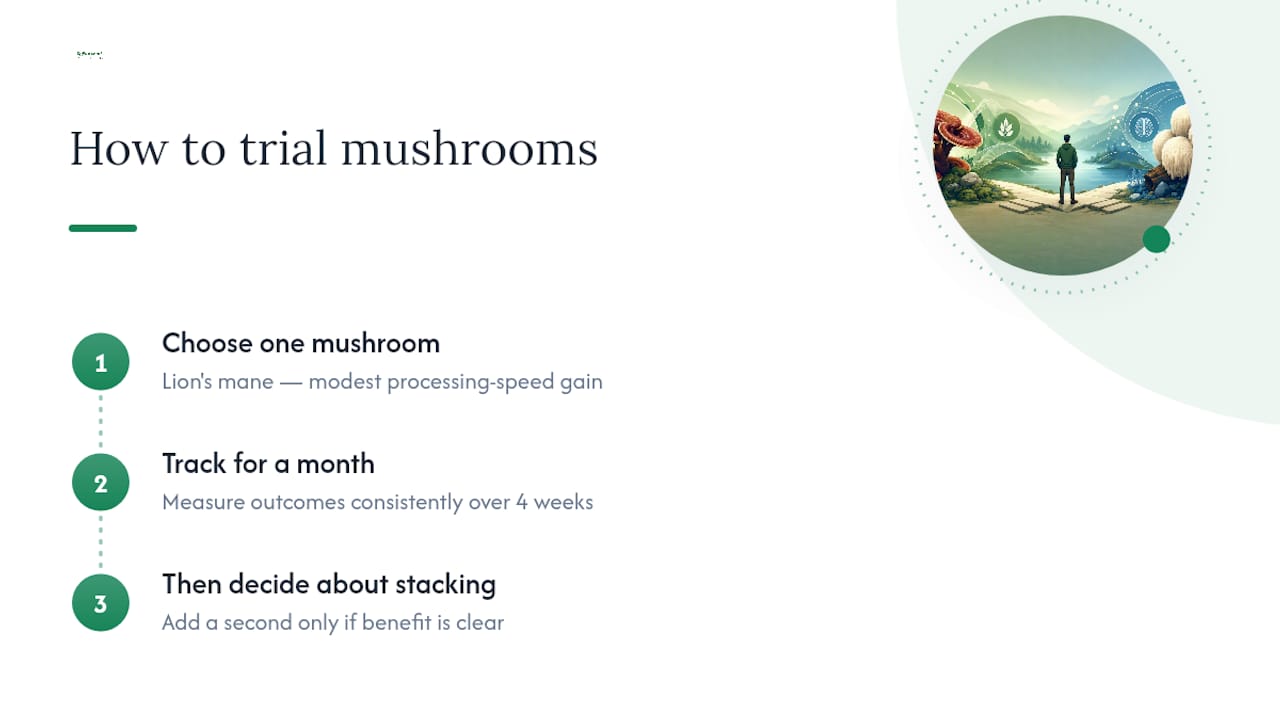
- Trial one mushroom for 4 to 6 weeks before stacking. This isolates which effects come from which mushroom, so you’re not guessing later if something feels off.
- Log outcomes as you go. A simple sleep diary, a quick focus task, or a mood scale gives you real data instead of vague impressions.
Pro Tip: Keep your log boring and consistent, same time of day, same three questions (focus, sleep quality, any side effects) so you can actually compare week one to week four instead of relying on memory.
How do you choose between lion’s mane and reishi for your goal?
Start with the outcome you’re actually trying to move, then work backwards to the mushroom and the label details that matter for that specific compound.
Match the goal first:
- Cognitive clarity, memory support, or mental sharpness → lion’s mane.
- Calm, sleep quality, or general immune support → reishi.
- Both goals at once → consider stacking, but trial separately first.
Check your baseline health before starting either:
- Current medications, especially anticoagulants or immunosuppressants.
- Existing sleep or anxiety issues that might respond to, or clash with, either mushroom.
- Any known mushroom allergy.
Read the label properly. Look for the species name, a per-mushroom milligram figure (not just a total “blend” number), the extract ratio, and whether it’s fruiting body or mycelium. A vague blend total tells you nothing about whether the product matches trial doses, and that’s the single most common way these supplements fail to deliver.
- Choose your mushroom based on your primary goal.
- Verify the label shows per-mushroom mg and extract ratio, checking our guide to mushroom gummy label checks if you want a fuller checklist.
- Start at the lower end of the dose range.
- Monitor for 4 to 6 weeks, logging effects and any early side effects.
- Adjust dose or switch mushroom based on what the log actually shows.
Gummies, capsules, and powders all deliver the same underlying compounds; the difference is convenience versus how easily you can verify what’s inside.
A brief note on how we’re framing the evidence here
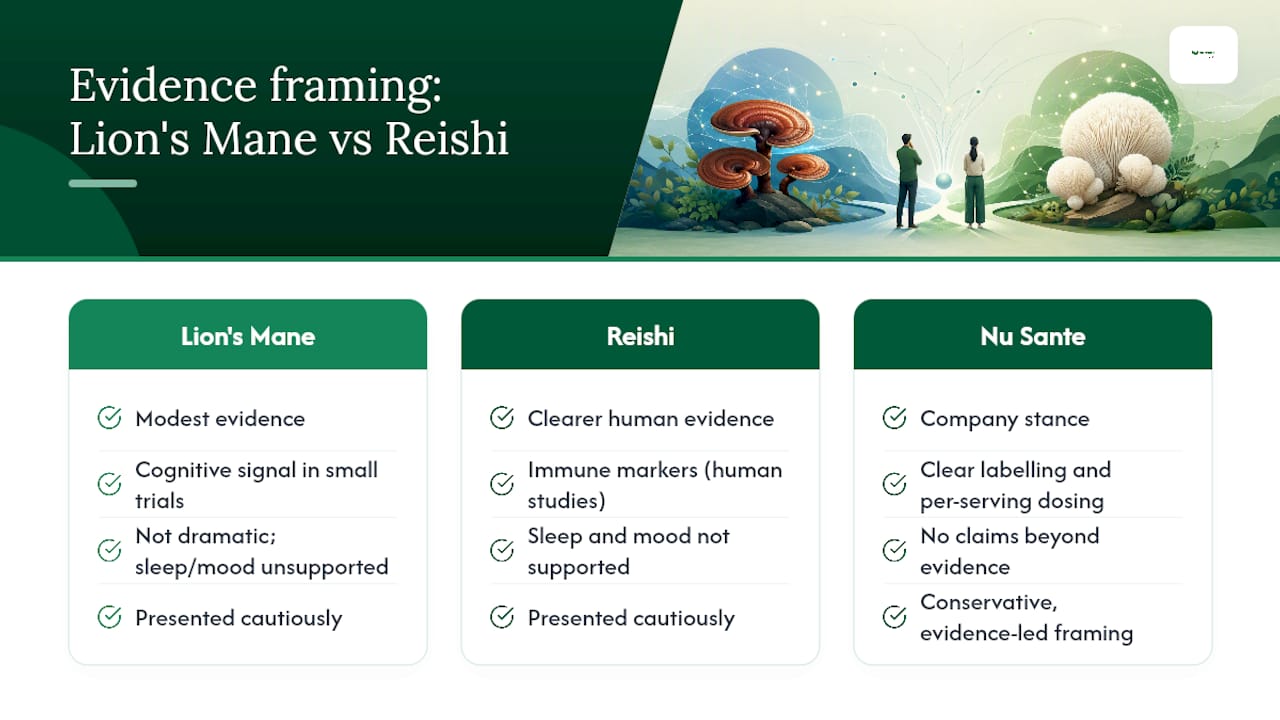
This comparison leans conservative on purpose. Lion’s mane shows a genuine but modest cognitive signal in small trials, not a dramatic one. Reishi’s clearest human evidence sits with immune markers, not sleep or mood, however traditional its reputation runs. Nu Sante Nutrition’s approach follows that same caution: clear labelling, consistent per-serving dosing, and no claims the evidence doesn’t support.
Editorial take: what the research actually supports
The honest reading of this evidence is less exciting than most marketing copy suggests, and that’s precisely the point. Lion’s mane has one of the better acute cognitive signals in the mushroom supplement world, but “modest improvement in processing speed” is a long way from “brain-boosting miracle.” Reishi’s strongest data point is an immune marker shift in healthy adults over 84 days, not the sweeping stress-and-sleep transformation often implied.
Where conventional advice falls short is treating these as interchangeable “wellness mushrooms” you can pick based on vibe. They aren’t. Lion’s mane and reishi solve different problems, and stacking them without first isolating each one’s effect just muddies your own feedback. If you take one lesson from this, it’s this: trial one mushroom, track it properly for a month, then decide whether a second one earns a place in your routine. Evidence-aware doesn’t mean evidence-proven, and treating supplements with that distinction in mind is what separates a useful routine from expensive guesswork.
— Andy
A convenient way to try lion’s mane or reishi daily
Mushroom Gummies provide an alternative to measuring powder or swallowing capsules every morning, designed for consistent daily dosing. The range emphasizes clear per-serving amounts, avoiding vague blend totals that obscure the actual content.
Whether you’re leaning towards lion’s mane for focus or reishi for calm and immune support, check the full Mushroom Gummies range to compare formats before starting your 4 to 6 week trial. Gummies aren’t a substitute for medical advice, so if you’re on regular medication, particularly anticoagulants or immunosuppressants, speak to your clinician before adding either mushroom to your routine. Browse the range now and match a product to the goal you settled on above.
This article is general information, not a substitute for advice from a qualified doctor. Consult a qualified healthcare professional about your own circumstances before acting on anything here.
Sources
- Pilot study of Hericium erinaceus acute cognitive effects (PMC10675414)
- Benefits, side effects, and uses of Hericium erinaceus as a supplement: a systematic review (Frontiers, 2025)
- Merck Manual — Reishi (Ganoderma lucidum)
- Reishi clinical trial reporting immune marker changes (PubMed 24266378)
FAQ
Can you take lion’s mane and reishi together?
Yes. No major direct interaction between the two has been reported, and many people take lion’s mane in the morning for focus and reishi in the evening for calm and immune support. Check with a clinician first if you’re on anticoagulants or immunosuppressants.
Who should not use reishi?
People on blood-thinning medication should be cautious, since reishi may have antiplatelet effects that raise bleeding risk. Anyone with an autoimmune condition, on immunosuppressants, or preparing for a transplant should also check with their prescriber first, given reishi’s immune-modulating action.
Why do I feel weird after taking lion’s mane?
Mild stomach upset or headache are the most commonly reported side effects, noted in a 2025 systematic review of human trials. These tend to settle as your body adjusts; persistent or severe reactions warrant stopping and checking with a doctor.
Is reishi a psychedelic?
No, reishi has no hallucinogenic or mind-altering properties. Its traditional “calming” reputation relates to immune modulation and possible effects on the body’s stress response system, not any psychoactive mechanism.
Is lion’s mane better than reishi?
Neither is “better” outright; they target different goals. Lion’s mane has the clearer human evidence for cognitive support, while reishi’s strongest signal is immune marker modulation, so the right choice depends on whether focus or calm and immune support is your priority.