

3–5 g Creatine for Vegetarians: Evidence and Vegan Gummies
Yes, most vegetarians and vegans benefit measurably from creatine supplementation, because plant-based diets provide little to no dietary creatine to begin with. Creatine monohydrate at 3–5 g a day is the best-evidenced form and dose, whether you load first or not. Almost all commercial creatine is synthetic and therefore vegan by nature, though it’s worth checking capsule shells, which sometimes use gelatin.
TL;DR:
- Vegetarians and vegans start with lower muscle and brain creatine stores, making supplementation more impactful for increasing physical and cognitive performance.
- Supplementing with 3–5 grams of creatine monohydrate daily can significantly boost creatine levels, especially for those on plant-based diets, with no need for cycling.
- Both loading and maintenance protocols quickly or gradually saturate muscles, with timing being largely irrelevant; consistent daily intake is key for best results.
- Vegan-friendly creatine supplements predominantly come in powdered form, with gummies and capsules requiring careful ingredient checks to ensure they contain no animal-derived components.
- Creatine is generally safe for healthy adults but should be used with caution by individuals with kidney issues, pregnant women, or those on medication, after consulting a healthcare professional.
Table of Contents
- Why vegetarian diets usually mean lower creatine stores
- Do vegetarians see real strength, power and cognitive gains?
- How should you dose creatine as a vegetarian or vegan?
- Choosing a vegan-friendly creatine product and format
- Is creatine safe for vegetarians and vegans, and who should be careful?
- Why we built a creatine gummy instead of another tub of powder
- Try Nu Sante Nutrition’s vegan-friendly creatine gummies
- Primary sources and further reading
- Sources
Why vegetarian diets usually mean lower creatine stores
Creatine reaches your muscles two ways: your body makes it from three amino acids (arginine, glycine and methionine), and you eat it directly from meat and fish. Vegetarians and vegans still get the amino-acid building blocks from lentils, tofu, nuts and grains, but those foods contain no creatine itself, only the raw materials your liver and kidneys use to synthesise a modest amount. Endogenous production covers baseline needs, but it doesn’t come close to matching what an omnivore gets from a steak.
That gap shows up consistently in the research. A systematic review of vegetarian creatine studies found vegetarians and vegans tend to start with lower muscle and blood creatine than people who eat meat regularly, a pattern nutrition writers have long attributed to the simple absence of dietary creatine in plant foods, as explained in this VegNews breakdown of creatine and vegan diets.
Here’s the part most people miss: starting lower isn’t a disadvantage when it comes to supplementing. It’s the opposite.
- Muscles have a ceiling for how much creatine they can hold, and if you’re starting well below that ceiling, there’s more room to fill.
- Vegetarians and vegans often see a sharper jump in muscle creatine once they supplement, sometimes described as a “super compensation” effect because the starting point was so much lower.
- That larger relative increase is one reason plant-based eaters frequently notice more obvious changes in strength or recovery than omnivores taking the same dose.
- Cognitive creatine stores in the brain follow a similar pattern, which matters because brain tissue relies on the same energy system muscles do.
In practical terms, if you’ve avoided meat and fish for years, you’re arguably one of the people creatine supplementation was made for. The lower your baseline, the more there is to gain, and the research backs that up rather than just assuming it.
Do vegetarians see real strength, power and cognitive gains?
The clearest data point comes from a 2020 systematic review focused specifically on vegetarians, which pooled randomised and prospective trials and found consistent increases in total muscle creatine and phosphocreatine after supplementation, alongside improvements in lean mass and some strength measures. The same review was upfront about its limits: several of the underlying studies carried moderate to high risk of bias, often from small sample sizes or short follow-up periods. That doesn’t erase the findings, but it means “creatine works for vegetarians” is a well-supported claim, not an absolute one.
Statistic Callout: Vegetarian participants in the reviewed trials showed larger increases in muscle creatine stores than omnivorous comparison groups, a pattern the systematic review attributes directly to lower starting levels rather than any difference in how the supplement is absorbed.
Cognitive outcomes are where things get genuinely interesting for anyone who assumes creatine is purely a gym supplement. Trials and meta-analyses have linked supplementation to improvements in short-term memory and processing speed, particularly in people whose baseline creatine was already low, according to meta-analytic evidence on cognitive outcomes. An earlier randomised trial gave vegetarian participants 5 g a day for several weeks and recorded gains in mental performance tasks compared with a placebo group, a result summarised in this earlier RCT on creatine and cognition. Since vegetarians and vegans are exactly the population likely to start with low baseline creatine, they’re also the population most likely to notice a cognitive shift, not just a physical one.
Where the evidence is strongest and weakest matters just as much as where it exists at all:
- Strongest signal: short-duration, high-intensity exercise, such as resistance training, sprinting and repeated power efforts, where phosphocreatine resynthesis is the limiting factor.
- Reasonably strong signal: lean mass gains over multi-week training programmes, especially when combined with resistance work.
- Emerging but promising: memory and processing speed, particularly in people with low starting creatine.
- Still limited: performance in elite-level competitive sport and long endurance events, where other physiological factors dominate and trial data is thinner.
None of this means creatine turns you into an elite athlete overnight. It means the mechanism behind the benefit, low starting stores filling up, applies unusually well to people who don’t eat meat or fish.
How should you dose creatine as a vegetarian or vegan?
You have two legitimate routes to the same destination, and neither is objectively “better,” just faster or slower.
- Loading protocol: take around 20 g a day, split into four 5 g doses, for five to seven days. This saturates muscle creatine stores quickly, which is useful if you have a training block or event coming up soon.
- Maintenance-only protocol: skip the loading phase and take 3–5 g a day consistently. You’ll reach the same saturation point as the loading approach, just over roughly three to four weeks instead of one, based on standard dosing protocols reported across clinical trials.
- Ongoing maintenance: once saturated, either route settles into the same 3–5 g daily dose indefinitely. There’s no need to keep loading or cycle off.
Timing genuinely doesn’t matter much. Morning, evening, before training, after training, it makes little measurable difference. What matters is that you take it every day, because creatine works through accumulation, not a single dose spiking your system. Pairing it with a carbohydrate-containing meal may help uptake slightly, but treat that as a nice-to-have, not a rule.
If you’re new to loading and worried about stomach upset, split any single dose above 5 g into smaller amounts through the day rather than taking it all at once, a tip covered in more detail in this guide to whether a loading phase is worth it. Dissolving powder fully in liquid before drinking also cuts down on the gritty aftertaste that puts a lot of people off using it consistently.

Pro Tip: If you keep forgetting your daily dose, tie it to an existing habit, brushing your teeth or making your morning coffee, rather than relying on willpower alone. Adherence over three to four weeks matters far more than getting the timing “perfect.”
Choosing a vegan-friendly creatine product and format
Creatine monohydrate is the form to buy. It has the deepest evidence base of any form on the market, including the vegetarian-specific trials referenced above, and it’s usually the cheapest per gram. Newer forms marketed as superior, such as creatine HCl, haven’t shown better outcomes in trials, a point covered in more depth in this comparison of monohydrate versus HCl. Micronised monohydrate, which is ground to a finer particle size, mixes more easily and is a sensible default if you’re buying powder.
Format is where vegetarians and vegans need to pay closer attention than omnivores do:
- Powder is almost always vegan, since the crystals themselves are produced synthetically in a lab rather than extracted from animal tissue.
- Gummies are convenient and tend to improve consistency for people who dislike swallowing powder or capsules, but check the ingredient list for the gelatin often used in traditional gummy bases, and confirm the gummy shell and any glaze are plant-derived.
- Capsules can be the trickiest format, because the capsule shell itself, not the creatine inside, is frequently made from gelatin unless it’s explicitly labelled vegetarian or vegan.
For anyone training competitively, look for third-party testing marks such as Informed Sport, which confirm a product has been screened for banned substances, a quality signal highlighted by Form Nutrition’s plant-based creatine guidance. Before adding anything to your basket, run through a short checklist: confirmed dose per serving, number of servings in the pack, any third-party test mark, and a clear allergen statement. That five-minute check avoids the awkward situation of discovering after the fact that your “vegan” supplement wasn’t quite what it claimed.
Is creatine safe for vegetarians and vegans, and who should be careful?
Most side effects reported with creatine are mild and manageable: some people experience bloating or transient stomach discomfort, particularly during a loading phase, which usually settles once you switch to maintenance doses or split larger amounts across the day.
- Splitting a single large dose into two or three smaller ones through the day reduces the chance of gastrointestinal discomfort.
- Staying properly hydrated helps, since creatine draws water into muscle cells.
- Track how you feel over the first week or two rather than assuming any discomfort means you should stop entirely.
Statistic Callout: Guidance from the NIH’s Office of Dietary Supplements states that creatine at recommended doses has not been shown to harm kidney function in healthy adults, though anyone with existing kidney disease should speak with a clinician before starting.
That safety profile assumes normal kidney health. If you have any diagnosed kidney condition, are pregnant or breastfeeding, or are supplementing a child, talk to a doctor first rather than relying on general guidance aimed at healthy adults. It’s also worth mentioning creatine use to your GP or pharmacist if you’re on regular medication, simply so any interaction can be ruled out rather than assumed. For readers specifically weighing up gummy formats, this breakdown of creatine gummy side effects covers what to expect from that delivery method in more detail.
Why we built a creatine gummy instead of another tub of powder
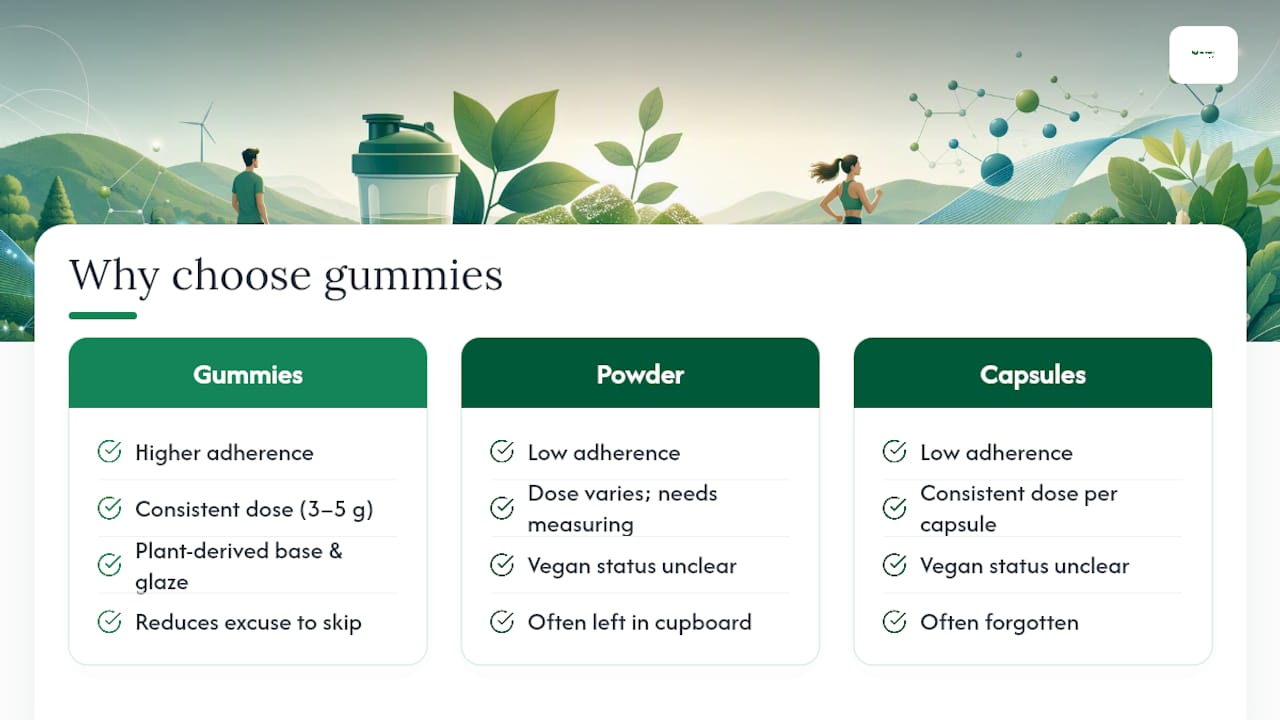
Andy here. Most of the vegetarian creatine research holds up well, and the biggest barrier isn’t whether the supplement works, it’s whether people actually take it every day for a month straight. Powder gets left in the cupboard. Capsules get forgotten. That’s the gap Nu Sante Nutrition’s creatine gummies are built to close: a format people are more likely to stick with because it doesn’t feel like a chore.
We’ve been deliberate about verifying that our gummy base and glazing agents are plant-derived, because “vegan-friendly” only means something if the label backs it up rather than assumes it. The dose is consistent per gummy too, which matters more than it sounds when you’re trying to hit 3–5 g daily without measuring powder on a kitchen scale. None of that replaces the evidence behind creatine monohydrate itself. It just removes the excuse not to use it.
— Andy
Try Nu Sante Nutrition’s vegan-friendly creatine gummies
Nu Sante Nutrition’s Creatine Gummies use creatine monohydrate, the same evidence-backed form covered throughout this guide, in a plant-based gummy that skips the gelatin shell capsules often rely on. Each serving delivers a measured dose designed to fit the 3–5 g maintenance range, so there’s no scooping powder or guessing at a spoonful.

A sensible starting routine looks like this: one serving daily, taken at the same point in your day, for three to four weeks to reach full saturation, then continued indefinitely as your maintenance dose. If you’d rather load faster, you can still combine gummies with a short higher-dose period, though most people find daily consistency does the job just as well over time. Head to the Nu Sante Nutrition store to see the full ingredient breakdown and current stock. As with any supplement, check with a doctor first if you’re pregnant, breastfeeding, or managing a kidney condition or ongoing medication.
Primary sources and further reading
- Benefits of Creatine Supplementation for Vegetarians Compared to Omnivorous Athletes: A Systematic Review
- Office of Dietary Supplements (NIH) — Exercise and athletic performance fact sheet
- PubMed: creatine dosing and performance outcomes
- PubMed: cognitive creatine trials and meta-analyses
- Creatine for Bone Health: Use It With Osteogenic Loading
This article is general information, not a substitute for advice from a qualified doctor. Consult a qualified healthcare professional about your own circumstances before acting on anything here.
Sources
- Benefits of Creatine Supplementation for Vegetarians Compared to Omnivorous Athletes: A Systematic Review
- Office of Dietary Supplements (NIH) — Exercise and athletic performance fact sheet
- PubMed index reference: studies on creatine dosing and performance outcomes
- PubMed entry for cognitive creatine trials and meta-analyses
- Form Nutrition — plant-based creatine product information