
3–5g Creatine + 300–600mg Ashwagandha: Safe Stack for Health Conscious Adults
Yes, most healthy adults can take creatine and ashwagandha together safely, since the two work through different pathways: creatine supports cellular energy for muscle and brain, while ashwagandha regulates the body’s stress response. At sensible doses (3–5g creatine, 300–600mg ashwagandha daily) they complement rather than clash. The main caveats: check with a doctor first if you take thyroid, blood pressure, or immune-suppressing medication, or have kidney concerns.
TL;DR:
- Combining creatine and ashwagandha is generally safe for healthy adults at recommended doses, but those on blood pressure, thyroid, or immune medications should consult a doctor before use.
- Creatine supports muscle and brain energy production, with a proven safety record and dose-dependent practices, including optional loading and consistent daily intake.
- Ashwagandha mainly reduces cortisol levels and perceived stress, with limited long-term safety data suggesting cycling rather than continuous use for several months.
- The stack benefits athletes under chronic stress, vegans, and busy professionals, by addressing energy production and stress regulation simultaneously.
- No large trials test the combination directly, but extensive individual evidence and mechanistic reasoning support the safety and efficacy of stacking creatine and ashwagandha.
Table of Contents
- What is creatine? Key benefits and safety profile
- What is ashwagandha? Effects, doses and evidence limits
- Why combine them? Complementary mechanisms and who benefits most
- What the research actually says about the combination
- Dosing, timing and practical protocols (how to take each safely)
- Potential side effects, interactions and red flags
- Who should be cautious and how to monitor progress
- Practical stacking protocol from a wellness brand perspective
- Author perspective and practical takeaway
- Getting started with creatine and ashwagandha gummies
- Sources
- FAQ
What is creatine? Key benefits and safety profile
Creatine is the most researched sports supplement on the market, and its mechanism is simple. It tops up phosphocreatine stores in muscle and brain tissue, giving cells a faster way to regenerate ATP, the molecule that fuels short bursts of effort. That is why it shows up in strength gains, sprint performance, and even resilience against mental fatigue during sleep deprivation.
The ISSN position stand on creatine sums up decades of trial data: creatine reliably increases intramuscular creatine stores, improves high-intensity exercise output, and carries a strong safety record when used as directed, supported by extensive trial data.
Dosing usually follows one of two patterns:
- Loading phase: around 20g per day, split into four doses, for five to seven days
- Maintenance: 3–5g per day, taken consistently, with or without a loading phase
- Timing flexibility: creatine works cumulatively, so exact timing matters less than daily consistency
- Hydration: because creatine draws water into muscle cells, adequate fluid intake reduces the risk of cramping or bloating
Mayo Clinic’s summary notes creatine is considered safe for most people at these doses, though anyone with existing kidney disease should speak to a clinician before starting. If you are weighing up whether a loading phase is worth the hassle, the short answer is that it speeds up saturation but is not essential for long-term results.
What is ashwagandha? Effects, doses and evidence limits
Ashwagandha is an adaptogen, a category of herbal compounds thought to help the body regulate its stress response rather than target one specific system. Its main studied effect is on cortisol, the hormone that spikes during physical and psychological stress.

A 2021 systematic review of 491 adults found significant reductions in cortisol and perceived stress compared with placebo over six to eight weeks, according to the NIH Office of Dietary Supplements. Clinical trials typically use between 125mg and 600mg of root extract per day, with the stronger stress and anxiety benefits generally reported at the higher end, 500 to 600mg. Standardised extracts such as KSM-66 are the format most trials rely on, which makes them a sensible reference point when checking a product label.
Where the evidence gets thinner is long-term safety. Key points on ashwagandha’s side-effect and evidence profile:
- Common mild effects include drowsiness, stomach upset, nausea, and diarrhoea
- Rare case reports have linked ashwagandha to liver injury, though causation is not firmly established
- Research beyond three months of continuous use remains limited, which is why many practitioners recommend cycling rather than year-round use
- Effects on cortisol and stress markers are consistent across trials, but sample sizes remain modest compared with creatine research
Harvard Health’s review of ashwagandha safety backs this cautious framing. If you are curious about dosing specifics, our guide to ashwagandha for anxiety breaks down the 300–600mg range in more depth.
Why combine them? Complementary mechanisms and who benefits most
Creatine and ashwagandha do not compete for the same biological real estate. Creatine works on cellular energy availability. Ashwagandha works on the hypothalamic-pituitary-adrenal axis, the system that governs your stress hormones. Stacking them means addressing two separate bottlenecks that often show up together: low training capacity and high background stress.
Three groups tend to notice the most benefit:
- Athletes training under chronic stress. A demanding job plus a hard training schedule can blunt recovery. Creatine supports the physical side, while ashwagandha may ease the mental load that makes recovery harder.
- Vegans and vegetarians. Dietary creatine comes almost entirely from meat and fish, so plant-based eaters typically start with lower muscle creatine stores and often see a more noticeable lift from supplementation, particularly in cognitive tasks.
- Busy professionals juggling cognitive load. Some research on creatine’s role in reducing fatigue during sleep deprivation, paired with ashwagandha’s cortisol-lowering effect, suggests a plausible combined benefit for people running on too little sleep and too much pressure, as this systematic review of ashwagandha in athletes and healthy adults outlines.
Set expectations honestly. This stack is not going to turn a sedentary week into a personal best, and it will not erase a genuinely stressful life. What it can plausibly do is give your training a firmer energy base while taking some edge off the daily grind. If you are an endurance athlete rather than a lifter, it is worth reading how creatine applies specifically to runners before assuming the standard strength-training dose applies to you.
What the research actually says about the combination
Nobody has run a large randomised trial testing creatine and ashwagandha together as a single stack. That is the honest starting point, and any article claiming otherwise is overreaching.
What exists instead is strong individual evidence for each ingredient, plus mechanistic reasoning that they should not interfere with one another. The ISSN position stand gives creatine one of the most robust safety and efficacy records in sports nutrition, built on decades of trials across different ages and training backgrounds. Ashwagandha’s evidence base, while genuinely promising, is younger and smaller in scale.
Small adaptogen-blend studies have shown improved strength and stress markers when combined with other supplements, and there is no obvious antagonism between creatine and ashwagandha’s respective mechanisms. But the absence of a head-to-head trial means confidence in the combination rests on inference, not direct proof.
A clinician-reviewed summary on this exact question, published by Ubie’s Doctor’s Note, concludes the combination appears safe for most healthy adults at recommended doses, while flagging hydration, blood pressure, and thyroid or kidney markers as the sensible things to monitor.
Where the confidence gap actually sits:
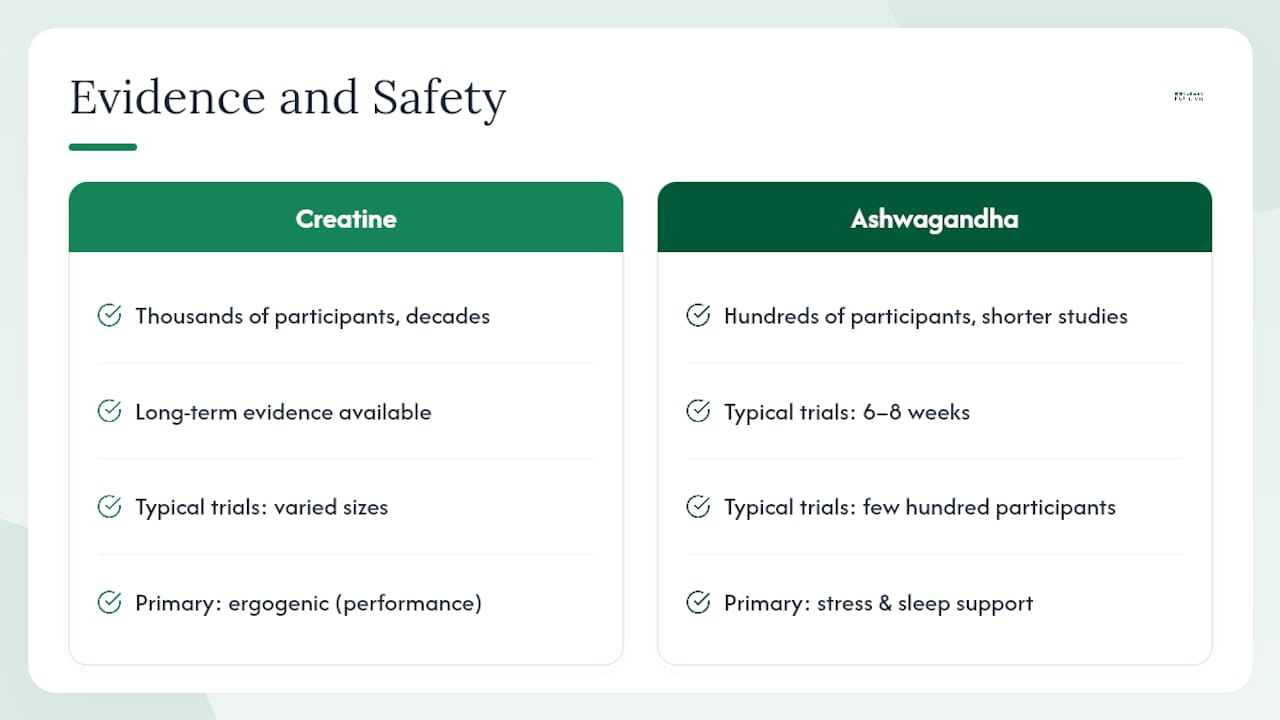
The Frontiers in Nutrition opinion piece on creatine makes a useful distinction: creatine’s evidence base spans thousands of participants across multiple decades, while ashwagandha trials, though methodologically sound, typically run six to eight weeks with a few hundred participants. That difference in scale does not make ashwagandha unsafe. It means the long-term picture, beyond three months of continuous use, is still being filled in.
Registered dietitians interviewed for Health.com’s ashwagandha coverage describe creatine as the established gold standard ergogenic aid, with ashwagandha chosen more for stress and sleep support, and note that many people already use both for different goals without realising they are, functionally, running a stack. That is arguably the most useful finding here: the combination is common practice, even if it has not been formally trialled as a unit.
Dosing, timing and practical protocols (how to take each safely)
Get the basics right and the stack largely runs itself. Creatine performs best with daily consistency, while ashwagandha responds better to a structured cycle.
Creatine regimen:
- Optional loading phase: around 20g/day split into four doses for five to seven days, then drop to maintenance
- Maintenance dose: 3–5g per day, taken with food or a drink to reduce stomach upset
- No need to cycle off creatine; consistency is what drives results
Ashwagandha regimen:
- Standard dose: 300–600mg per day of standardised root extract, such as KSM-66
- Cycle length: six to eight weeks on, followed by a break of similar length, given the limited long-term safety data
- Take with food to reduce the chance of nausea
A workable timing split many experienced users follow is creatine in the morning, to support daytime training and cognitive tasks, and ashwagandha in the evening, to support wind-down and sleep, according to Health.com’s usage notes. Splitting doses and drinking enough water across the day also helps offset the mild water retention creatine can cause, a point the Cleveland Clinic makes clear in its creatine guidance.
Pro Tip: If you notice bloating in the first week, reduce your creatine dose to 3g, take it with a full glass of water, and reassess after five days rather than stopping altogether. Most GI discomfort with creatine settles once your body adjusts.
If GI upset persists past two weeks, or ashwagandha leaves you drowsy through the morning, that is a signal to adjust dose or timing rather than push through it. Our piece on when to take ashwagandha covers scheduling tweaks for exactly this scenario.
Potential side effects, interactions and red flags
Most side effects from this stack are mild and manageable, but a smaller set of interactions deserve real attention before you start.
Common, mild effects:
- Drowsiness or a groggy feeling, particularly from ashwagandha taken earlier in the day
- Nausea or stomach upset from either supplement, usually eased by taking with food
- Bloating or water retention from creatine, especially during a loading phase
Less common but worth knowing:
- Rare case reports connect ashwagandha to liver injury, which is part of why extended, unmonitored use is not advised
- Ashwagandha may lower blood pressure and interact with thyroid hormone levels, according to guidance from the Merck Manuals
- Creatine’s water-retention effect can complicate readings for anyone monitoring blood pressure or kidney markers closely
Medication classes that warrant a conversation with a clinician before starting either supplement:
- Antihypertensives (blood pressure medication), because ashwagandha may compound the blood-pressure-lowering effect
- Thyroid medication, since ashwagandha can influence thyroid hormone levels
- Immunosuppressants, because ashwagandha’s immune-modulating action could interfere with treatment
- Anticoagulants or blood thinners, where herbal supplements generally carry a caution flag
None of this means the stack is risky for the average healthy adult. It means the people on these medication types are exactly the ones who should not be self-directing this decision. For more detail on the side-effect profile specifically, see our breakdown of ashwagandha side effects.
Who should be cautious and how to monitor progress
Certain groups should treat this stack as a “ask first, start later” situation rather than a straightforward purchase.
- Pregnant or breastfeeding women, and anyone under 18 should avoid starting either supplement without direct medical guidance, since safety data for these groups is thin.
- People with kidney disease, thyroid conditions, or significant comorbidities need a baseline check before starting and periodic follow-up while using either supplement.
- Anyone on the medication classes listed above should get explicit clearance from their GP or specialist first.
For everyone else, a simple baseline before starting, and a follow-up around six to eight weeks in, is a reasonable structure. Useful markers to ask a clinician about include blood pressure, creatinine (a kidney function marker), liver function tests, and thyroid-stimulating hormone (TSH) where relevant.
Keep it simple on your end: a quick weekly note on sleep quality, perceived stress, and training performance gives you and your clinician something concrete to review, rather than relying on vague impressions of “feeling better.”
Practical stacking protocol from a wellness brand perspective
Creatine Gummies and Ashwagandha Gummies exist to make this whole protocol less of a chore, without pretending gummies change the underlying science. The doses that matter are the same ones covered above; the format is simply easier to stick to daily.
Practical points worth knowing before you build a gummy-based routine:
- Match gummy servings to trial doses. Check the label against the 3–5g creatine and 300–600mg ashwagandha ranges used in clinical research, and adjust the number of gummies accordingly rather than assuming one serving automatically hits the studied dose.
- Morning and evening split works well with gummies too. Creatine gummies in the morning alongside breakfast, ashwagandha gummies in the evening with dinner, mirrors the timing pattern many experienced users already follow.
- Cycle ashwagandha, not creatine. Six to eight weeks on, then a break, applies whether you are taking capsules or gummies.
- Look for standardised extracts and third-party testing. A gummy is only as good as what is inside it, so check for a named, standardised extract (such as KSM-66) and evidence of independent quality testing rather than a vague “ashwagandha blend” on the label.
For readers who want the deeper dive into scheduling around gummies specifically, our guide on reducing stress with ashwagandha gummies covers the practical side in more detail. The format changes the delivery, not the underlying dosing logic.
Author perspective and practical takeaway
For a typical healthy adult without a complicating medical condition, this stack is one of the more defensible supplement combinations on the market, precisely because it does not rely on hype. Creatine has the deepest evidence base of any sports supplement in existence. Ashwagandha’s evidence, while younger, points consistently in one direction: lower perceived stress, better sleep quality for many users.
What gets overlooked is that the biggest risk here is not the combination itself. It is skipping the basic homework, taking ashwagandha for months without a break, or ignoring a medication interaction because “it’s just a supplement.” Treat the stack with the same seriousness you would treat any daily medication, get a baseline check if you fall into a cautious group, and it becomes a genuinely low-drama addition to a routine. If you are on regular medication or managing a health condition, talk to your GP before you start, and browse Nu Sante Nutrition’s product range once you have that green light.
— Andy
Getting started with creatine and ashwagandha gummies
Capsules and powders work, but they demand a routine most people abandon by week three. The Creatine Gummies and Ashwagandha Gummies are built around the same doses covered throughout this article, in a format that fits into a morning coffee or an evening wind-down without measuring scoops or swallowing chalky tablets.
That convenience matters more than it sounds. The supplements that work are the ones you actually take consistently for the six to eight weeks trials suggest you need to see a benefit. The gummies are formulated with standardised extracts and clear per-serving dosing, so you can match them against the ranges discussed above rather than guessing. Before you start, especially if you take regular medication or manage a health condition, speak to your GP. Once you have that confirmation, visit Nu Sante Nutrition’s Ashwagandha Gummies page to check current formulations and find the option that fits your routine.
This article is general information, not a substitute for advice from a qualified doctor. Consult a qualified healthcare professional about your own circumstances before acting on anything here.
Sources
- Ashwagandha: Usefulness and Safety | ODS (NIH)
- Creatine - Mayo Clinic
- International Society of Sports Nutrition position stand on creatine
FAQ
Can you take creatine and ashwagandha together?
Yes, for most healthy adults, since the two work through separate mechanisms and no research suggests they interfere with each other. Anyone on thyroid, blood pressure, or immunosuppressant medication should confirm with a clinician first.
What should you not mix with ashwagandha?
Avoid combining ashwagandha with blood-pressure medication, thyroid medication, sedatives, and immunosuppressants without medical guidance, since it can amplify or interfere with these drugs. Alcohol in large amounts may also worsen the drowsiness some people experience.
What should you not mix with creatine?
Creatine has few known interactions, but caution is advised alongside nephrotoxic medications (drugs that stress the kidneys) and for anyone with existing kidney disease. Combining creatine with excessive caffeine may also reduce some of its performance benefits in a minority of studies.
What is the dark side of ashwagandha?
The main concerns are rare but serious reports of liver injury, drowsiness, and gastrointestinal upset, alongside a genuine lack of safety data beyond three months of continuous use. That gap is why cycling on and off, rather than taking it indefinitely, is the more cautious approach.