

3–5g Creatine + 10g Collagen: A Safe Daily Routine for Busy Adults
Yes, most healthy adults can take creatine and collagen together without issue. They work through separate pathways, target different tissues, and there’s no documented harmful interaction between them. The main caveats: speak to a GP first if you have kidney disease, are pregnant or breastfeeding, or have known allergies to bovine, marine, or chicken-derived collagen.
TL;DR:
- Creatine and collagen are absorbed via different transporters, so taking them together does not hinder their individual uptake or effectiveness.
- Creatine mainly benefits muscle strength and recovery, while collagen supports joint, tendon, and skin health, making them complementary for training and aging.
- Safety concerns are mostly related to kidney health, pregnancy, allergies, and hydration, requiring caution and consultation with a healthcare provider if necessary.
- The recommended daily doses are 3 to 5 grams of creatine and 5 to 15 grams of collagen, with timing flexibility except for collagen pre-exercise intake.
- Current research shows strong evidence for creatine’s muscle benefits but only limited, smaller trials support collagen’s joint and skin improvements, with no direct studies on combined use.
Table of Contents
- How do creatine and collagen work in the body?
- What benefits can you expect from combining them?
- Is it safe to combine creatine and collagen?
- What’s the best dosing and timing protocol?
- Does research actually support taking them together?
- Who’s behind this guidance?
- Where the common advice on this stack gets it wrong
- Nu Sante Nutrition: an easy option for a combined routine
- Sources
How do creatine and collagen work in the body?
Creatine and collagen solve completely different problems, which is exactly why they don’t compete with each other once swallowed.
Creatine works inside muscle cells. Roughly 95% of the body’s creatine sits in skeletal muscle, where it’s converted to phosphocreatine and acts as a rapid energy buffer for regenerating ATP during short, intense efforts. A dedicated transporter called SLC6A8 pulls creatine from the bloodstream into muscle tissue. This is why creatine has such consistent evidence for strength, power output, and recovery between sets.
Collagen peptides take a different route entirely. When you drink hydrolysed collagen, digestive enzymes break it down into small peptides rich in glycine, proline, and hydroxyproline, which cross the gut wall largely through a transporter called PepT1. These amino acids become raw material for the body’s own collagen production in skin, tendons, and cartilage. Vitamin C plays a specific role here: it’s a required cofactor for the enzymes that hydroxylate proline and lysine, a step that stabilises the collagen molecule’s triple helix structure. Without adequate vitamin C, that step slows down.
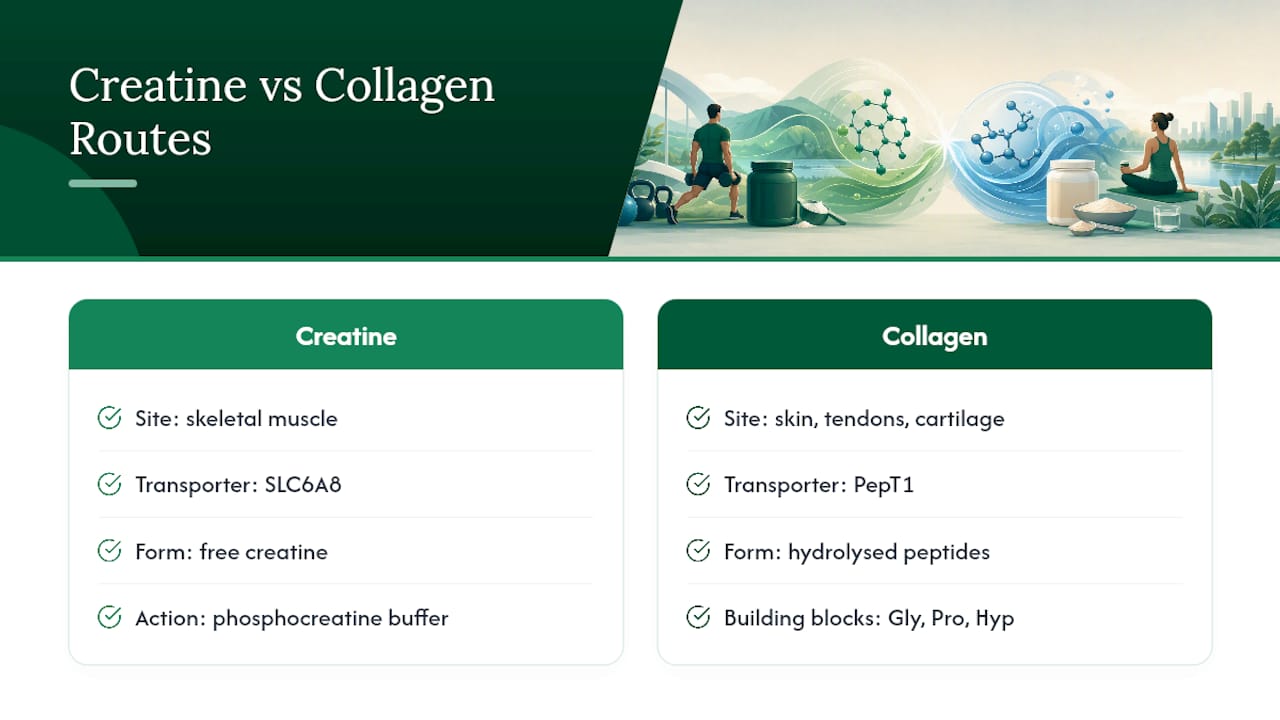
Because creatine relies on SLC6A8 and collagen peptides rely on PepT1, there’s no meaningful competition for absorption when you take them at the same time. Interestingly, some research suggests creatine itself may support skin biology beyond muscle. A review of creatine and skin health found that topical and oral creatine improved cellular energy availability in dermal cells and appeared to influence collagen-related pathways, hinting at some biological overlap between the two supplements even though they arrive via different transporters.
What benefits can you expect from combining them?
Each supplement earns its evidence in different arenas, and knowing which is which stops you from expecting the wrong outcome.
Creatine has one of the strongest safety and efficacy records in sports nutrition. Meta-analyses consistently link it to gains in strength, power, and lean mass, alongside secondary benefits for recovery between training sessions and, in some trials, cognitive performance under fatigue. Collagen’s evidence base is smaller but coherent: randomised trials point towards reduced activity-related joint discomfort, improved tendon-related outcomes, and modest gains on certain skin measures like elasticity and hydration.
Put together, the two supplements complement rather than duplicate each other:
- Creatine helps muscles produce more force and recover faster between sessions.
- Collagen supplies the amino acid building blocks connective tissue needs to keep pace with that increased training load.
- Neither one substitutes for the other. Collagen is an incomplete protein and shouldn’t be relied on as your main protein source for muscle growth, regardless of how much creatine you’re taking.
- The pairing suits people training hard enough that joints and tendons feel the strain before muscles do.
Who gets the most out of this? Resistance trainers pushing heavier loads, older adults managing the natural decline in both muscle mass and connective tissue resilience, and anyone nursing a tendon niggle while still wanting to train. If your main goal is bigger muscles and nothing else, creatine plus a complete protein source does more work than creatine plus collagen alone.
Is it safe to combine creatine and collagen?
The honest answer is that both supplements have good individual safety profiles, but a handful of situations warrant caution before you start.
The clearest flag concerns kidney health. Creatine is considered safe for most healthy adults, but anyone with pre-existing kidney disease or reduced kidney function should get clearance from a doctor first. Creatine also raises creatinine readings on standard blood tests, which can look like impaired kidney function to a clinician who doesn’t know you’re supplementing.
- Pregnancy and breastfeeding: evidence on creatine use here is limited, so check with a clinician before starting either supplement.
- Allergies: collagen is derived from bovine, marine, or chicken sources. Check the label carefully if you have a known allergy, and read up on marine versus bovine collagen if you’re unsure which source suits you.
- Mild GI upset: some people experience bloating or cramping with creatine, especially during loading. Splitting the dose across the day and taking it with food usually resolves this.
- Water retention: creatine draws water into muscle cells, so stay well hydrated, particularly in the first fortnight.
If you’re already managing a kidney condition or take regular blood tests, our guide on creatine gummies and side effects covers what to flag to your GP before starting.
Pro Tip: Tell your doctor you’re taking creatine before any routine blood panel. A creatinine reading that looks slightly high might just reflect your supplement, not a kidney problem, but only your GP can make that call with full information.
What’s the best dosing and timing protocol?
You don’t need a complicated schedule to get the benefit from both supplements. Consistency matters more than precision timing, with one exception for collagen.
Creatine monohydrate has a well-established maintenance dose of 3 to 5 grams daily, taken at any time of day, since what matters is topping up muscle stores consistently rather than hitting a precise window. Collagen peptides are typically dosed at 5 to 15 grams daily, with tendon-focused studies often using 10 grams roughly an hour before exercise alongside around 50mg of vitamin C to support the hydroxylation step collagen synthesis depends on.
A simple combined routine:
- Pre-workout (60 minutes before training): 10g collagen peptides + 50mg vitamin C, mixed in water or juice.
- Any time, daily: 3 to 5g creatine monohydrate, taken with a meal to reduce the chance of stomach upset.
- On rest days: keep the creatine dose consistent; collagen can shift to morning or evening since there’s no exercise session to time it around.
You can mix creatine and collagen in the same shake if that’s more convenient. Creatine is stable at neutral pH and collagen peptides dissolve readily, so combining them for short-term use causes no chemical issue.
Some people prefer a creatine loading phase (around 20g daily split into four doses for five to seven days) to saturate muscle stores faster, but this isn’t necessary for long-term benefit and raises the odds of bloating. Our breakdown of the creatine loading phase walks through the trade-offs if you’re deciding between the two approaches. Whichever protocol you choose, drink enough water across the day, particularly during the first couple of weeks.
Does research actually support taking them together?
Here’s where honesty matters more than marketing. The evidence for creatine’s muscle benefits is deep and consistent. The evidence for collagen’s joint and tendon benefits is real but thinner, usually built on smaller trials with specific timing protocols. What’s genuinely missing is any high-quality randomised trial testing the combined stack directly.
That gap matters for how you frame expectations:
- Creatine’s benefits for strength and power sit on a large body of research spanning decades.
- Collagen’s benefits for tendons and joint comfort come from a smaller set of trials, several using the pre-exercise plus vitamin C protocol referenced above.
- No published trial has tested whether taking both together produces anything beyond the sum of their separate effects.
The biological rationale for pairing them is sound: different transporters, different target tissues, no known conflict. But sound reasoning isn’t proof of synergy, and readers deserve that distinction rather than a marketing shortcut.
Treat the stack as two well-supported interventions running in parallel, not as one supplement with combined superpowers. If your priority is joint health specifically, our evidence-based guide to joint supplements covers the wider landscape beyond just collagen.
Who’s behind this guidance?
This piece was written by Andy for the Nusante blog, where recurring coverage includes collagen timing protocols and comparisons of creatine forms for different training goals. Nusante’s product range, spanning creatine, collagen, and complementary formulas, exists specifically because capsules and powders create friction that stops people from staying consistent day after day. For readers wanting bone-specific detail beyond skin and tendon outcomes, this overview of collagen and bone health from Sacramento Bone Health adds useful background on connective tissue biology.
Where the common advice on this stack gets it wrong
Most articles on this topic either oversell the combination as a “synergy” or bury the sensible parts under excessive caution. Neither serves you well. The judgement the evidence actually supports is narrower and more useful: creatine works, collagen probably helps connective tissue, and mixing them causes no known harm. That’s not a thrilling headline, but it’s accurate.

Where conventional advice falls short is in treating collagen like an afterthought bolted onto a creatine routine. If you’re training hard enough to need creatine’s strength benefits, your tendons and joints are absorbing that same load, and collagen’s amino acid profile is arguably more relevant to you than to a sedentary person taking it purely for skin.
What should you prioritise first? Get the creatine dose right and consistent. It’s the piece with the strongest evidence and the lowest room for error. Layer collagen on top once that habit sticks, with vitamin C timing as a secondary refinement, not the main event. Overthinking the collagen timing while skipping creatine days is the most common mistake I see people make with this stack.
— Andy
Nu Sante Nutrition: an easy option for a combined routine
Getting the timing right on paper is one thing. Remembering to mix a shake before every session, on top of a powder tub and a separate collagen scoop, is where most people’s good intentions quietly fall apart. Nu Sante Nutrition built its Creatine Gummies and Collagen Gummies specifically for that gap: no mixing, no measuring, no gritty aftertaste, just a consistent daily dose you can take anywhere.

The gummy format doesn’t change the fundamentals covered above. You still want to check the collagen source against any allergies, and anyone with kidney concerns should still get clearance before starting creatine, whatever form it comes in. If you’re pregnant or breastfeeding, the same guidance on collagen during pregnancy applies regardless of format. What changes is how easy consistency becomes when the supplement fits into a routine rather than working against it. Browse the full Nusante range to see how the gummies map onto the daily protocol outlined here.
This article is general information, not a substitute for advice from a qualified doctor. Consult a qualified healthcare professional about your own circumstances before acting on anything here.
Sources
- Creatine monohydrate (Mayo Clinic)
- Review: creatine and skin health (PMC7910963)
- FormBlends: Can you take creatine and collagen peptides together?