

Ashwagandha for women: benefits, safety, and dosing
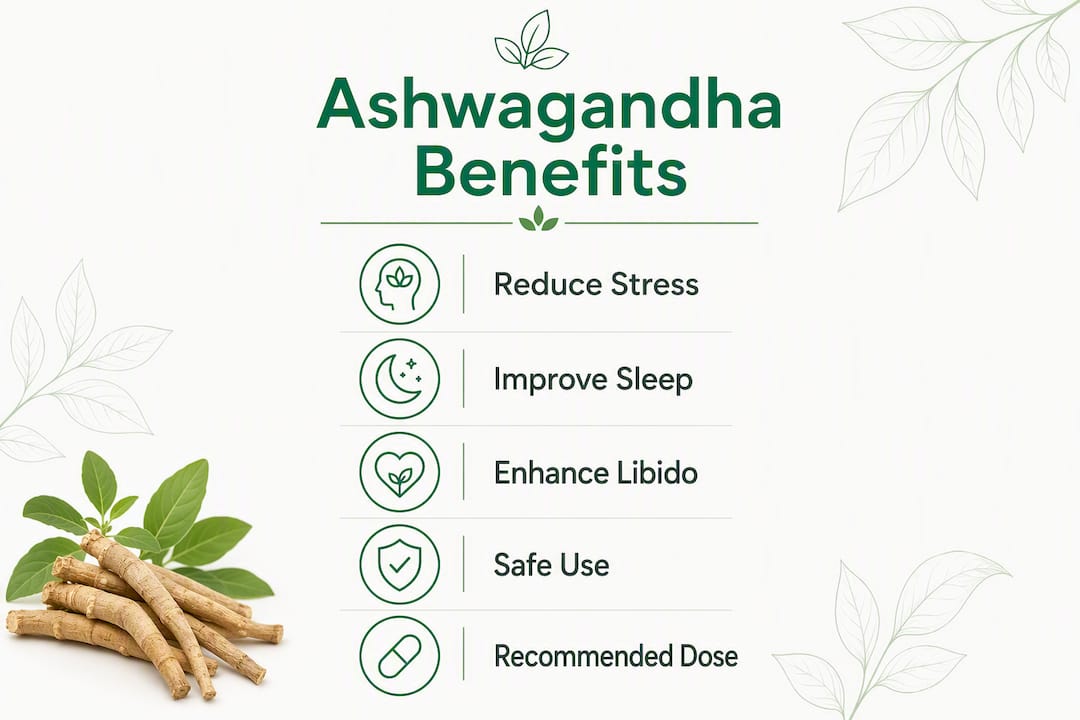
Ashwagandha is a reasonable supportive option for many women dealing with stress, poor sleep, low libido, or perimenopausal symptoms. It is not a hormone replacement. It works alongside the body’s stress and reproductive axes rather than as a substitute for oestrogen or progesterone. The evidence is strongest for stress reduction and sexual function, moderate for sleep and menopause-related quality of life, and still early for menstrual cycle irregularities and fertility.
Quick reference:
- Typical dose used in trials: 300–600 mg/day of standardised root extract, usually split as 300 mg twice daily
- Expected timeline: most measurable benefits appear after 6–8 weeks of consistent use
- Pregnancy and breastfeeding: avoid unless a GP advises otherwise; human safety data are insufficient
- Speak to your GP first if you take thyroid medication, sedatives, or immunosuppressants, or if you have an endocrine condition
Table of Contents
- How does ashwagandha work in the female body?
- What does the evidence say for each outcome?
- What dose and form should you take?
- Is ashwagandha safe, and who should avoid it?
- What should you expect after starting, and how do you monitor progress?
- Can you take ashwagandha alongside HRT during menopause?
- Does ashwagandha work differently across female age groups?
- Key takeaways
- A practical perspective on ashwagandha in women’s wellness
- Nu Sante Nutrition Ashwagandha Gummies: a UK option worth considering
- Useful sources
How does ashwagandha work in the female body?
Ashwagandha’s primary action is modulating the hypothalamic-pituitary-adrenal (HPA) axis and, in women specifically, the hypothalamic-pituitary-gonadal (HPG) axis. Put simply: it damps down the chronic stress response and supports the hormonal signalling chain that governs the menstrual cycle and reproductive function.
The key mechanistic pathways relevant to women:
- HPA modulation and cortisol reduction: withanolides, the active compounds in standardised extracts, reduce cortisol output by acting on the HPA axis. Lower cortisol protects against the downstream suppression of reproductive hormones that chronic stress causes.
- HPG axis effects: narrative review evidence shows ashwagandha can normalise gonadotropins and support estradiol levels in preclinical models relevant to PCOS and PMS. Critically, it does not appear to raise testosterone in women, which removes a common androgen-related concern.
- GABAergic activity: ashwagandha has mild GABAergic effects, which partly explains its anxiolytic and sleep-supporting properties.
- Anti-inflammatory action: withanolides inhibit NF-κB signalling, reducing systemic inflammation linked to mood disruption and cycle-related pain.
Standardised extracts matter here. Raw ashwagandha root powder has highly variable withanolide content. A product standardised to a declared withanolide percentage (commonly 2.5–5%) delivers a consistent active dose; raw powder does not.
Pro Tip: Check the label for two things: a declared withanolide percentage and evidence of third-party batch testing. If neither is listed, the product’s clinical relevance is uncertain regardless of the mg stated.
What does the evidence say for each outcome?
The table below maps each outcome to evidence strength, the dose used in the best available trials, and the key source.
| Outcome | Evidence strength | Typical trial dose | Key source |
|---|---|---|---|
| Stress and perceived anxiety | Moderate | 300–600 mg/day | NIH ODS review |
| Sleep quality | Moderate | 300–600 mg/day | NIH ODS review |
| Female sexual function | Moderate (women-specific RCT) | 300 mg twice daily | Randomised trial, PubMed |
| Menopause-related symptoms | Moderate (perimenopausal RCT) | 300 mg twice daily | MSKCC clinical summary |
| PMS and cycle irregularities | Low to moderate | 300–600 mg/day | Hormonal modulation review |
| Fertility and reproductive outcomes | Low (mostly preclinical) | Not established | Hormonal modulation review |
| Thyroid function support | Insufficient | Not established | NCCIH |
For stress and anxiety: multiple trials using standardised extracts report reductions in perceived stress and cortisol. The NIH Office of Dietary Supplements grades this as the best-supported use, though most trials are short (8–12 weeks) and conducted in mixed-sex populations.
For sexual function: a women-specific randomised controlled trial (n=80) found significant improvement across Female Sexual Function Index (FSFI) domains at eight weeks with 300 mg twice daily. Adverse events were comparable to placebo. This is one of the few trials designed exclusively for women, which makes it particularly relevant.
For menopause symptoms: perimenopausal trial data, summarised by Memorial Sloan Kettering Cancer Center, show improvements in climacteric symptoms and quality of life versus placebo. The effect is supportive rather than oestrogen-equivalent.
On fertility: the evidence is largely preclinical. Ashwagandha shows promise in animal models for restoring ovarian function, but human reproductive outcome trials are absent. Women trying to conceive should discuss use with a fertility specialist before starting.
For evidence on ashwagandha’s effects on libido, the FSFI trial data are the strongest human signal currently available.
What dose and form should you take?
Clinical trials generally used moderate daily doses of standardised root extract, often split into two doses taken with meals to reduce GI discomfort.
Comparing common formats:
- Standardised extract capsules: the most studied format. Dose per capsule is explicit, withanolide content is often declared, and they are straightforward to match to trial doses.
- Gummies: convenient and easier to take consistently, which matters for an 8-week protocol. The key requirement is that the per-gummy mg and withanolide standardisation are clearly stated on the label. When they are, gummies are a clinically equivalent delivery format.
- Root powder: highly variable withanolide content. Difficult to dose accurately. Not recommended when clinical outcomes are the goal.
- Tinctures: absorption may differ; dose standardisation is harder to verify. Limited trial data use this format.
For UK shoppers, the practical checklist is short:
- Declared withanolide percentage on the label (not just total mg)
- Third-party batch testing certificate available on request or on the product page
- Clear per-portion mg (not just “proprietary blend”)
- Allergen labelling compliant with UK food supplement regulations
- No undisclosed fillers or artificial additives
Pro Tip: If a gummy product lists total ashwagandha extract per serving rather than per gummy, divide the serving total by the number of gummies per serving to get the per-gummy dose. A two-gummy serving of 600 mg extract delivers 300 mg per gummy. If the label is ambiguous, contact the brand directly before purchasing.
For a broader look at how gummy formats compare on quality criteria, the magnesium glycinate gummies buyer’s guide covers the same label-reading principles.

Is ashwagandha safe, and who should avoid it?
At typical trial doses of standardised extract, ashwagandha is generally well tolerated. The important cautions are specific and worth knowing clearly.
Common side effects:
- Mild GI upset, particularly on an empty stomach
- Drowsiness, especially at higher doses or when combined with sedatives
- Loose stools in some individuals at doses above 600 mg/day
Drug interactions to discuss with your GP:
- Sedatives and anxiolytics: additive CNS depression; avoid combining without medical supervision
- Thyroid medications (levothyroxine): ashwagandha may influence thyroid hormone levels; women on thyroid medication need monitoring if they add ashwagandha
- Immunosuppressants: ashwagandha has immunomodulatory properties that may interfere with immunosuppressant drugs
- Antidiabetic medications: some evidence of blood glucose lowering; monitor if on insulin or oral hypoglycaemics
Pregnancy and breastfeeding:
Stop ashwagandha if you are pregnant or planning to become pregnant. Despite some reassessment of historical abortifacient claims, a systematic review confirms that large-scale human safety trials are absent. Regulators and clinicians advise avoidance until that evidence exists. The same applies to breastfeeding: no adequate human safety data are available. Do not take ashwagandha gummies while pregnant or breastfeeding without explicit GP guidance.
Memorial Sloan Kettering Cancer Center and the NCCIH both flag pregnancy and sedative interactions as the primary cautions. For further reading on supplement safety in pregnancy, the Nu Sante Nutrition guide on collagen during pregnancy illustrates the same evidence-first approach to supplement decisions.
This article is general information, not medical advice. Confirm current guidance with your GP or a qualified healthcare professional before starting any supplement.

What should you expect after starting, and how do you monitor progress?
Most trial benefits appear after several weeks of consistent daily dosing. Sleep quality and sexual function metrics sometimes show earlier movement, but the RCT data place the most robust changes at around eight weeks.
Practical monitoring steps:
- Baseline symptom score: note your stress, sleep quality, and any cycle or sexual function concerns before starting, using a simple 1–10 scale
- Sleep diary: track sleep onset, duration, and morning alertness weekly
- Cycle tracking: note cycle length, PMS severity, and any irregularities before and during use
- Sexual function notes: simple frequency and satisfaction ratings are sufficient; formal FSFI questionnaires are available free online if you want a structured measure
- Thyroid and cortisol testing: only if clinically indicated; discuss with your GP if you have a thyroid condition or suspect adrenal dysfunction
Eight-week timeline:
- Weeks 1–2: assess tolerability. GI side effects, if they occur, usually appear here. Take with food.
- Weeks 3–6: initial changes in sleep onset and stress perception are often reported in this window.
- Weeks 6–12: most measurable effects on sexual function, mood, and menopause-related symptoms appear in this range.
Stop and seek GP review if you notice: worsening low mood or anxiety, new palpitations, irregular or unexplained bleeding, confirmed pregnancy, or persistent sedation that affects daily function.
For broader context on sleep supplement options, the evidence-based UK sleep supplement guide covers how ashwagandha fits alongside other approaches.
Can you take ashwagandha alongside HRT during menopause?
No clinical trials have directly tested ashwagandha combined with hormone replacement therapy (HRT). What the evidence does show is that ashwagandha addresses different mechanisms than HRT, which means the two are not redundant.
HRT replaces declining oestrogen and progesterone directly. Ashwagandha modulates the stress response and supports HPG axis signalling. For perimenopausal women, the combination is theoretically complementary: HRT manages vasomotor symptoms (hot flushes, night sweats) while ashwagandha may support mood, sleep quality, and stress resilience. The perimenopausal RCT data summarised by Memorial Sloan Kettering Cancer Center show improvements in climacteric quality of life, but this trial did not include women already on HRT.
The practical guidance is straightforward. If you are on HRT, tell your prescribing GP or gynaecologist before adding ashwagandha. The main interaction concern is thyroid function: some women on HRT also take levothyroxine, and ashwagandha’s thyroid-modulating properties mean thyroid hormone levels should be monitored. There is no evidence of a direct pharmacokinetic interaction between ashwagandha and standard HRT preparations (oestradiol patches, gels, or tablets), but the absence of trial data means caution is appropriate.
Women who are not candidates for HRT, or who prefer not to use it, sometimes use ashwagandha as a standalone supportive option for mood and sleep during perimenopause. The evidence supports modest benefit in that context, though it does not replicate the vasomotor symptom relief that HRT provides.
Does ashwagandha work differently across female age groups?
The short answer is yes, and the differences are meaningful.
Adolescents and young adults (under 25): there are no dedicated trials in adolescent females. The HPA axis is still maturing in this group, and the long-term effects of exogenous adaptogen use on hormonal development are unknown. Use in this age group is not supported by current evidence and warrants particular caution.
Reproductive-age women (roughly 25–45): this is the most studied group. The sexual function RCT, the stress and cortisol trials, and the PMS-focused narrative reviews all draw primarily from this population. The hormonal modulation review specifically addresses PCOS and PMS in reproductive-age women, noting that ashwagandha’s HPG axis effects may help normalise gonadotropins without androgenic side effects. Women with PCOS, in particular, may find the cortisol-lowering and HPG-normalising effects relevant, though this remains an area where evidence is still building.
Perimenopausal women (roughly 45–55): the clearest age-specific trial data exist here. Randomised trial evidence shows improvements in climacteric symptoms and quality of life. The stress-resilience and sleep benefits are also particularly relevant during this transition, when cortisol dysregulation often compounds hormonal fluctuation.
Post-menopausal women: limited direct evidence. The anti-inflammatory and GABAergic properties may still support mood and sleep, but the HPG axis effects become less relevant after menopause. Any use should be discussed with a GP, particularly given the higher likelihood of concurrent medications in this age group.
Key takeaways
Ashwagandha offers women the most reliable support for stress, sleep, and sexual function when taken as a standardised extract at 300–600 mg/day for at least eight weeks.
| Point | Details |
|---|---|
| Best-supported outcomes | Stress reduction, sleep quality, and female sexual function have the strongest trial evidence. |
| Standard dose range | 300–600 mg/day of standardised root extract, typically 300 mg twice daily with food. |
| Timeline for results | Most measurable changes appear at 6–8 weeks; monitor tolerability in the first two weeks. |
| Pregnancy and interactions | Avoid during pregnancy and breastfeeding; consult a GP if on thyroid, sedative, or immunosuppressant medication. |
| UK product option | Nu Sante Nutrition’s Ashwagandha Gummies offer a convenient, clearly dosed UK format for consistent daily use. |
A practical perspective on ashwagandha in women’s wellness
The evidence for ashwagandha in women is more specific than most supplement coverage suggests, and that specificity is worth paying attention to. The stress and sexual function data are genuinely encouraging. The fertility and thyroid data are not there yet. That gap matters when women are making decisions about their health.
What tends to get lost in the broader conversation is the dose and standardisation question. A gummy or capsule with an undeclared withanolide content is not the same product as the one used in the RCTs. The clinical outcomes in those trials were achieved with standardised extracts at defined doses over defined periods. Choosing a product that matches those parameters is not a minor detail.
For women considering ashwagandha alongside HRT, or who have thyroid conditions, the interaction picture is not alarming but it does require a conversation with a GP rather than a self-managed decision. The same applies to anyone in the perimenopausal transition who is already managing multiple symptoms with multiple interventions. Ashwagandha fits well as a supportive layer, not as a replacement for medical care.
The most sensible approach: pick a standardised product, give it eight weeks, track your symptoms, and keep your GP informed if you are on any relevant medication.
Nu Sante Nutrition Ashwagandha Gummies: a UK option worth considering
Women who want the convenience of a gummy format without sacrificing dose clarity have a straightforward UK option. Nu Sante Nutrition’s Ashwagandha Gummies are formulated with standardised root extract, with per-serving dosing clearly stated so you can map it directly to the 300–600 mg/day range used in clinical trials.
Gummies remove the compliance barrier that capsules and powders often create. For an 8-week protocol, that consistency matters. Nu Sante Nutrition ships across the UK, and the product page includes full ingredient and allergen information. If you are looking for a stress and wellness supplement that fits a daily routine without complexity, the Ashwagandha Gummies are a practical starting point.
Browse the full range and check current availability at the Nu Sante Nutrition store.
Useful sources
The sources below are the highest-quality references for women researching ashwagandha. Bring the clinical trial links to any GP conversation about starting or stopping use.
- Ashwagandha: Usefulness and Safety — NCCIH (National Center for Complementary and Integrative Health)
- Ashwagandha: Is it helpful for stress, anxiety, or sleep? — NIH Office of Dietary Supplements
- Efficacy and Safety of Ashwagandha Root Extract for Improvement of Sexual Health in Healthy Women — PubMed RCT
- Withania somnifera in Women’s Hormonal Modulation: A Narrative Review (PCOS and PMS) — PubMed
- Systematic review: safety signals and evidence gaps for Withania somnifera in pregnancy — PubMed
- Ashwagandha clinical summary — Memorial Sloan Kettering Cancer Center
- Ashwagandha During Pregnancy: Is It Safe? — Healthline